

On Center Stage
Congress is mulling literacy legislation. It’s a mixed bag, IMHO.
Chad Aldeman nailed the 8th grade reading conundrum. Every state has upper grade reading woes, and the Southern Surge states are holding their own on the NAEP (while also excelling for low-SES students). Put some respect on their names.
Ed Tech Backlash Watch
Sixteen states have introduced bills to limit Ed Tech in schools.
Moms for Liberty and teachers unions are teaming up to push them through, in the ultimate “wasn’t on my 2026 bingo card” development.
Fortune headline: “America’s math and reading scores tanked after schools ditched textbooks for screens—and AI could worsen the brain rot”
The New York Times asks teachers if there’s too much screen time in school. (Answer: yes.) Now, they are issuing a student survey.
Utah dumps tech-enabled programs.
Pennsylvania joins New Jersey in mandating cursive, in a quest to make pencil and paper great again.
The Literacy Zeitgeist
Holly Korbey unpacks England’s phonics revolution with a guest essay from Mark Goodrich. We have much to learn from the Brits, including their hybrid phonics approach.
Doug Lemov joined Substack, and his first post featured a lesson from Laura Stam, which felt like kismet.
Doug’s encore summarized Dan Willingham’s essential points on the cognitive privilege of stories. <swoon>
Olivia Mullins makes a stellar case for science as a springboard for oral language development.
Natalie Wexler reminds us that Most Struggling Students Get “Incoherent” Instruction (and standards for “HQIM” are dead).
Kate Crist & friends introduced the Secondary Literacy Commons with a focus on fluency in middle grades.
The comments section of Claude Goldenberg’s latest felt like a throwback to Literacy Twitter.
Learning on Learning
Seriously, you have to read Becky Allen’s “Engelmann Last”:
“How do I communicate this so learners necessarily acquire it? Engelmann gives a precise answer to that question. If you know exactly what discrimination or procedure students must learn, his machinery can ensure they learn it reliably.
He is a novel theorist of instructional communication, and not so much a theorist of knowledge or curriculum design.
That contribution is immensely valuable. But it is not the whole of instructional design.
It is the end of it.
Sit with this: “Students told they'd have to teach material recalled ~31% more than those preparing for a test. Nobody actually taught. Just expecting to explain something shifts your brain from passively absorbing to actively organizing.”
Paul Kirschner unpacks contextual interference — why stability feels safe but makes learning fragile.
EduChatter
The College Board watered down AP expectations, because standards are dead.
The Lighter Side of Learning
I love a good math joke, and Pi Day delivered.
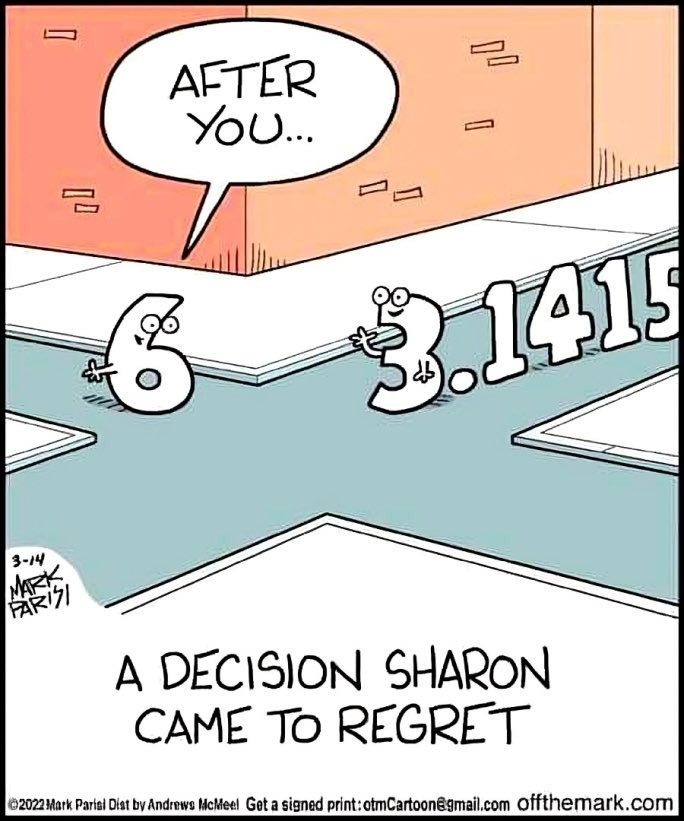
Not to be outdone, the Ides of March reminded us that cultural literacy starts with literacy.

Coming Attractions
TODAY! Read Washington hosts a conversation with Freddy Hiebert on ways AI can support vocabulary development.
Learning and the Brain is live from New York (and virtually) on April 16-18. Featuring Dan Willingham, Natalie Wexler, Sarah Oberle, Leslie Laud, ++.
Mark your calendars for ResearchEd NYC on May 2nd. I’m speaking, and hope to see you!
ResearchEd St. Louis has been announced for September. Apply to speak by 5/15.
Thanks for reading! Nominate a story for this newsletter here.
For Spring Break, this newsletter will take a hiatus. Instead, on Easter weekend, I’m resurrecting must-read favorites from the last few years. See what I did there?
What’s the most essential literacy reading of this era? Nominate a story for the Throwback Newsletter here.
You refer to the lively discussion on Claude Goldenberg's blog--and I agree. In his follow-up blog, I quoted a comment you made, which I responded to:
"'I'm dismayed than an anti-knowledge building curriculum camp persists within the Science of Reading community (of all things!), and the rot goes all the way to the Reading League.'" Nobody can accuse Susan Neuman of being 'anti-knowledge building', but I haven't seen her context that I cite in my latest comprehension post (https://harriettjanetos.substack.com/p/in-a-dark-dark-wood-the-first-casualty?r=5spuf) as part of any serious discussion by the 'pro-knowledge building' camp. Oversimplification is another type of rot."
I really appreciate how Olivia Mullins and others in the comments section of my blog are making the effort to engage with the need to contextualize this important discussion. We can't just sort ourselves into camps and call it a day.