

The literacy discourse is Overwhelming Like Maycember.
On Center Stage
A new report from the Educational Opportunity Project at Stanford proclaimed a “reading recession.”
The New York Times coverage was sobering. A viral tweet of this graphic had 2.5M views:
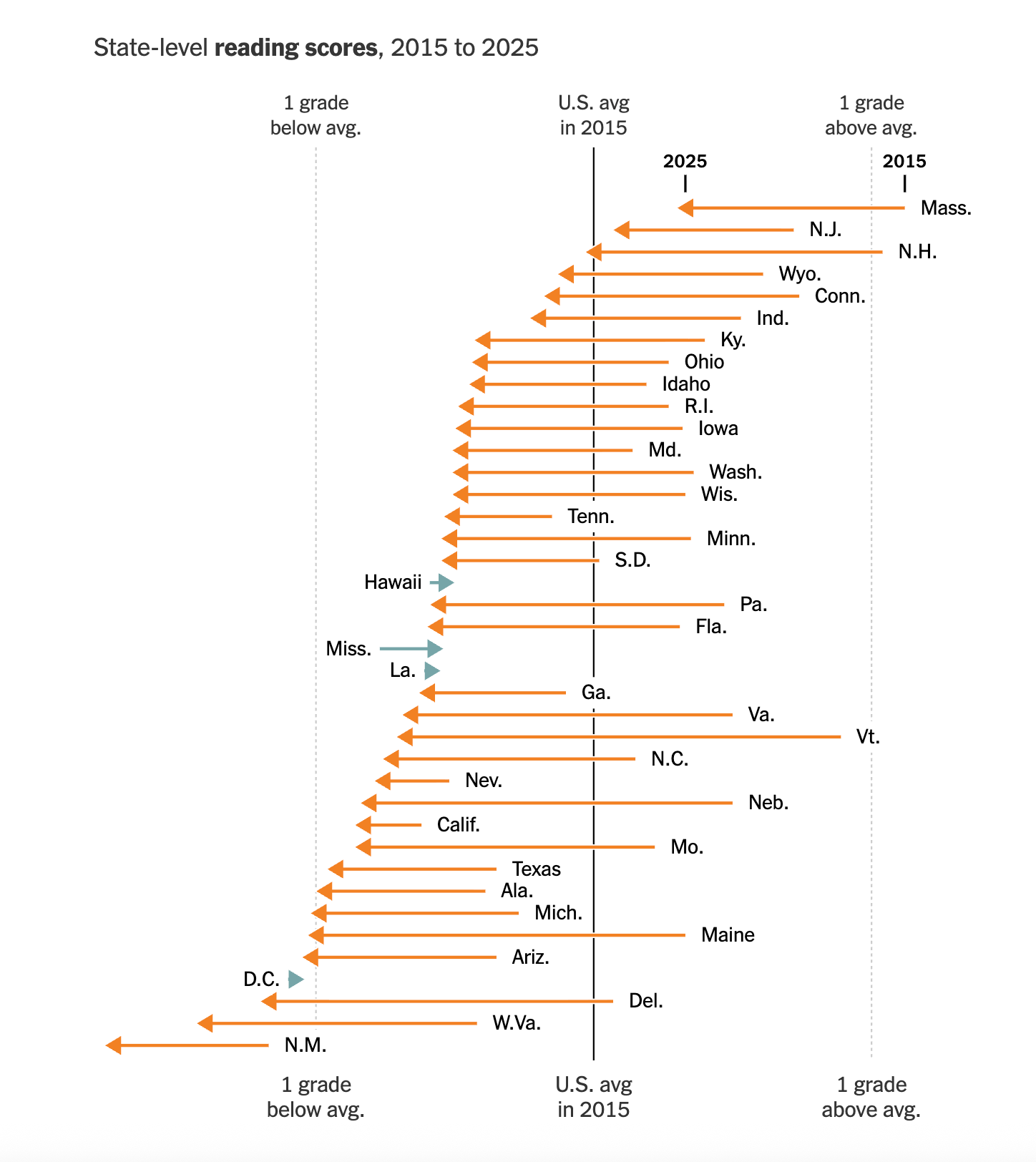
The New York Times also published a tool to make it easier to compare your district’s outcomes to state outcomes. I wish it did more to adjust for demographics.
Florida’s declines earned NPR coverage. It didn’t explicitly say Florida is awash in basals, but a Pasco school board member noted that “students spend more time reading and analyzing passages instead of complete books,” plus too much time on technology, so… the signs were there. Narrator: Florida is, in fact, awash in basals.
The RAND Report Reverberates
Y’ALL. The RAND report on books in English Language Arts deserves a more nuanced look. I explored the good, the bad, and the confusing, and hope you will give it a read, because folks—including the RAND authors—are missing the devil in the details.
Here’s just one example: Robert Pondiscio’s column on the report features Doug Lemov, whose approach to teaching books is truly exemplary.
Yet Doug’s superb curriculum (Reading Reconsidered) doesn’t qualify as “standards-aligned” under the RAND framework—and appears on exactly zero state-approved curriculum lists.
Market failures are keeping exemplary, book-rich curricula off state lists in favor of basals, and that’s the elephant in the room. Webinars with Doug Lemov are good, but addressing the gatekeeping of his curriculum will help more teachers.
Confusion Reigns
Kristen McQuillan spotted a different flavor of curriculum confusion in the Fordham report: it commingled supplements, interventions, comprehensive programs, and possibly also PD/frameworks under the heading of “curriculum.”
Kristen is spot on. Even state curriculum lists fail the categorization test.
Both recent reports share a common 🚩🚩🚩: the field can’t agree on curriculum quality—and can’t even agree on what counts as curriculum. (I’d say it’s time to pump the brakes on curriculum mandates.)
Fortunately, Kristen’s field guide offers an excellent starting point for the conversation.
Cool Tool
Nidhi Sachdeva and Jim Hewett launched an AI-enabled tool, The Evidence Checker, to make it easier for teachers to get research-based answers to classroom questions. Swoon.
The Literacy Zeitgeist
In a new study, “more time spent on phonics was associated with lower DIBELS scores, whereas more time spent on comprehension was linked with higher scores on the standardized tests designed to evaluate literacy skills in K-8 students,” as reported in EdWeek.
Day care centers are tracking conversational turns to promote oral language development. Swoon.
The Secondary Literacy Commons shared advice on success with multisyllabic words.
Learning on Learning
Michele Caracappa and Leslie Kim launched a podcast on systemwide learning improvement, starting with intervention and curriculum adoption.
Holly Korbey has a reality check: In Math, Worksheets Rule.
A study says “seductive details” in curriculum only work when they are coherent with the content.
New York state’s curriculum reforms are falling flat, as 130 districts continue to use balanced literacy curricula.
One Philly school saw a 20 point jump in reading outcomes while adopting new curriuclum, outpacing the district. Their secret: keeping PLC time “sacred.”
EduChatter
A study out of Florida, the first state to ban cell phones, suggests that bans promote academic gains and other upsides. This study got a tiny fraction of the attention given to last week’s Yondr pouch study, which suggested less upside.
Studies show third grade retention policies shape adult behavior, per Chad Aldeman.
Rick Hess shared Five Lessons for School Reformers, and I’m the Amen Choir for lines like this:
“Reform done poorly is often worse than no reform at all.”
The NAEP Civics test may get a revamp, including state-level results.
My ASU+GSV panel on the Southern Surge, with MS/LA/TN leaders, has been released as a podcast.
Ed Tech Backlash Watch
Lower Merion has emerged as the epicenter of Ed Tech backlash. More than 600 parents have signed a petition seeking the right to opt out of devices. The district says they can’t. There are 8500 students in the district. Roughly 5-9% of the district’s enrollment is represented by a petition signature—an imperfect proxy, but still a significant parent movement. The media coverage has shifted from local to national. A story to watch.
Tyler Kingkade reported on the iReady backlash. (I was honored to see the Curriculum Insight Project quoted!). Hoo boy, this segment:
‘Rocio Rivas, the school board’s VP, said at an April 21 board meeting that she spoke to district educators about i-Ready, and “I have yet to hear a positive comment.” Dozens of parents burst into applause in response.’
Tech Talk
Holly Korbey reports on the schools embracing AI, for tutoring and beyond.
Coming Attractions
June 9th: the SoR Classroom Teachers Teach Teachers series features the viral Word Mapping Project.
June 30th: the free Teaching That Succeeds symposium. Speaker announcements coming soon!
Beyond the Edusphere
Teens are Night Owl Scrolling: ‘New JAMA Pediatrics data shows U.S. adolescents log 50 minutes of smartphone use on school nights—mostly TikTok, Instagram and YouTube. Over half scrolled between midnight and 4 a.m. The researchers warn that even small sleep losses are linked to worse cognition and mental health in teens.’
There is such a massive gap between flashy tech promises and what a teacher can actually manage in a forty-minute period. We see a similar hurdle when helping everyday professionals learn new software; if it takes three hours to learn a ten-minute shortcut, people shut down. Grounding the conversation in practical, low-overhead workflows is the only way forward.
Thanks for this! Might be a problem just for me but the Philly school link comes up with a 403 forbidden message when I try to click on it.