

It started with a call from Carl Hendrick. When Carl—one of the most brilliant educators on the planet—asks you to work on a project, the only correct answer is Yes.
The project was at Alpha School. Carl was building a team of Learning Scientists to help Alpha improve its learning apps. It was already a really good team. They needed early reading specialists.
To be honest, I was hesitant. The first generation of EdTech was worse-than-underwhelming1. Frankly, I believe weak EdTech is a leading culprit in the decline of student outcomes over the last decade. It had soured my enthusiasm for learning-via-screens, and I knew Carl had similar sentiments.
Still, I was Alpha-curious, having been intrigued by the parent blog about Alpha’s motivation model. I told Carl I could do some part-time consulting. Because Carl Hendrick, amirite?
I figured I’d last a few months, just long enough to form my own take on Alpha.
Fast forward three seasons…
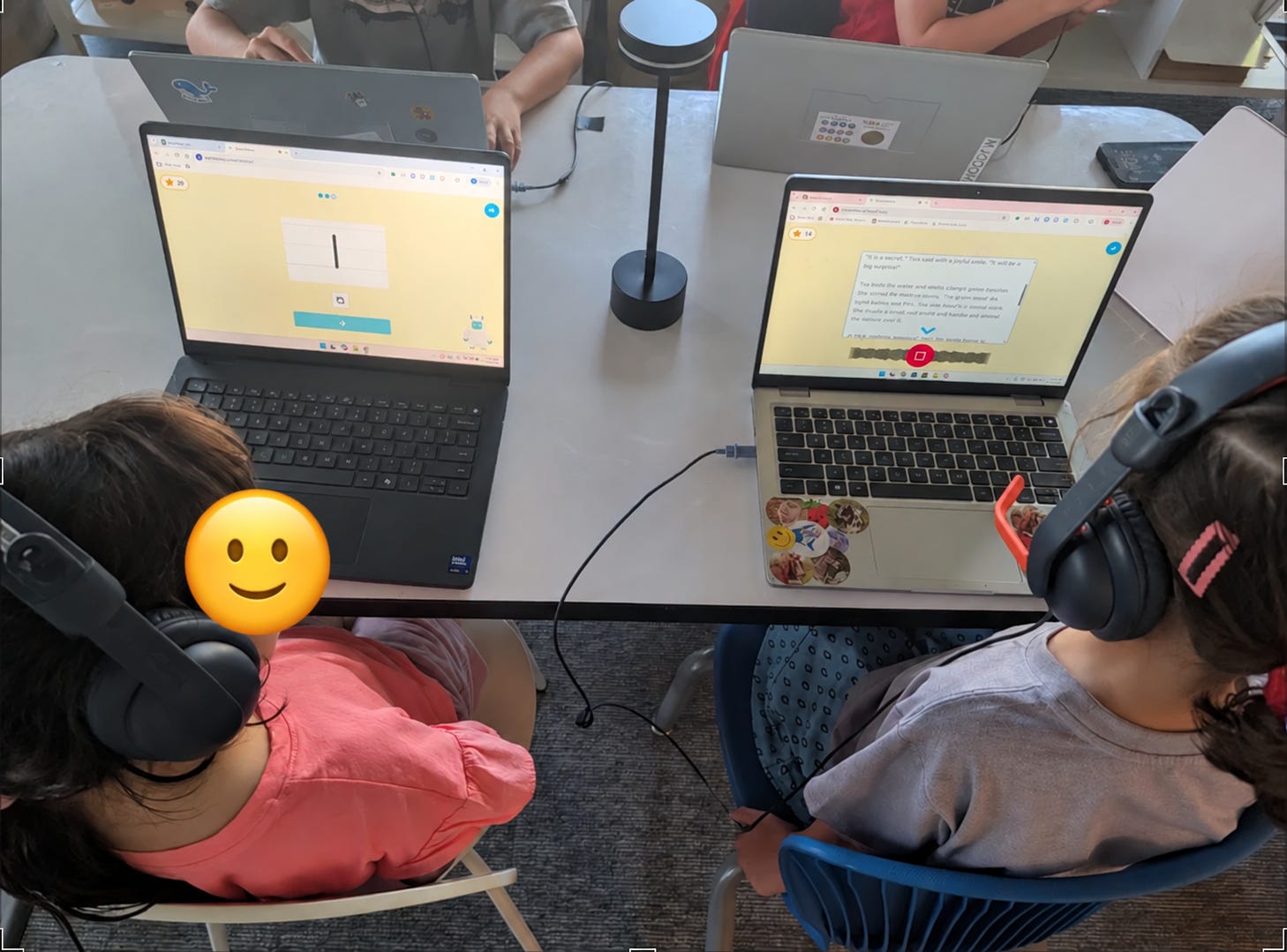
I’m currently introducing my second app into Alpha classrooms, as part of its growing team of Learning Scientists. Our first early reading app, Alpha Phonics, completely changed my thinking about what’s possible in the AI era.
My journey revealed the incredible potential in Alpha’s approach—something I never thought I’d say.
Now, I’m part of a quest to push the boundaries of what’s possible in teaching and learning.
This news will probably shock many of you. Yet it’s actually the most natural, logical progression of my career2. Allow me to explain, and to give you a small window into poorly-understood Alpha.
What is Alpha School?
The Very Online People in K-12 education have heard about Alpha School, the new(ish) private school network with a disruptive model for education.
Alpha designs the school experience around a compressed “two hour learning” academic block, using AI-enabled, personalized apps to streamline the learning experience. This frees up most of the school day for engaging activities and life skills development, in service of Alpha’s first principle: that “kids should love school.” Alpha also developed an unconventional model for motivating students. Overall, it’s quite different from school-as-we-know-it.
If you are just learning about Alpha, this recent TV segment offers a short intro (you’ll find additional reading in the footnotes).
In any case, here’s what you should know.
Alpha is a Rorschach Test
Few in the Eduverse have visited an Alpha school, and misinformation has been rampant3. So most Alpha discourse consists of people reacting to the idea of Alpha, based on their priors.
EdTech and AI skeptics dislike Alpha. Believers in tech-enabled personalized learning adore it.
School choice advocates and opponents split on Alpha, in predictable fashion.
Amusingly, both sides of the Instruction Wars see Alpha as “on their side.4”
For an honest read of Alpha, you need to get under the hood. That hasn’t been easy, because…
Alpha is a Startup
People tend to talk as if Alpha is a fully-baked, fixed entity.
I describe Alpha as a startup—and I would know. It’s my seventh career startup, in fact. My own team offers a perfect illustration.
Over the last two years, Alpha has been recruiting the world’s sharpest educators to replace third-party apps with its own. I’m part of this Learning Science team, in the early reading group.
Six months ago, we debuted Alpha Phonics, a homegrown app outperforming its predecessor on every level.
More recently, we developed a knowledge-building reading app, to immerse students in science- and history-rich learning through work with whole books. Our K-2 version is currently being piloted by hundreds of students.
I have been on a crusade to bring books into the Alpha curriculum, in elementary grades and beyond. Students always read great books in the life skills portion of the school day, but the curriculum needed a book-centered revamp. This school year, it’s getting one.
I know this is all new information.
One fair critique of Alpha Is that its website doesn’t contain as much information about its curriculum and learning experience as it should. In this way, Alpha has a very normal startup problem: the team is so busy building the product, they don’t always find the time to capture its virtues for an external audience. Also, the rapid pace of change makes it difficult to pin down reality (a problem on steroids in the AI era). Whatever I tell you about our apps today will be out of date in a week—an exhilarating reality.
This brings me to Alpha’s biggest advantage: we have a closed-loop ecosystem. Meaning: we build the apps, our own students use them, and we carefully measure their progress, so we have daily insight into what’s working and what isn’t. Thanks to the speed of AI-enabled development, we can tweak the apps overnight.
It’s a dream setup for R&D. Also, the sense of responsibility hits different when your own students are the users.
Perhaps because of my career path, I embrace the entrepreneurial spirit of it all. Startups try things, double-down on what works, and discard what doesn’t. They improve the model as they grow. This, too, is exhilarating.
And it means we haven’t seen the final state of Alpha. Multiple aspects of its work have evolved since I arrived, just ten months ago. A few were my own influence. In my experience with Joe Liemandt, he listens and responds to a good case for change. This, too, was a reason to join Alpha.
Venture capitalists say that you’re betting on the team more than the product when evaluating a startup. The product will change. The strategy can change. The question is whether you have people who will learn and pivot fast enough to win.
By that standard, I’d bet heavily on Alpha.
And on that note…
Introducing Alpha Learning Science
Alpha now boasts the best Learning Science team on the planet. You know about Carl Hendrick, and perhaps also Becky Allen (the world’s foremost assessment expert) and Zach Groshell, who’ve been public about their work.
Y’all, the bench is a lot deeper than that.
Today, the Alpha Learning Science team has more than two dozen members, all from the leading edge of global education. I bet you’ve read their books and Substacks, listened to their conference presentations, and attended their webinars. We’ll publish more about the group’s collective accomplishments soon.
I’m actually the only non-educator in Learning Science (because every team needs a token curriculum specialist with software development and usability experience). The team’s collective classroom experience is one of our superpowers.
To date, most Learning Scientists have chosen not to broadcast their work at Alpha. It’s easy to explain why… have you seen the way Alpha haters treated Carl Hendrick? He’s the most brilliant learning scientist on the planet—and the victim of a sometimes-vicious smear campaign for his work at Alpha. Which, uhhh, put a damper on enthusiasm for public sharing.
The community standards need to change. We need to give the world a window into our work. Also, no one deserves abuse for choosing to work at a pioneering, still-proving-itself innovation lab.
So, I’m launching my own work into the public square, in hopes we can establish a new normal for how Alpha’s team is treated. It’s the only way we can offer insight into our work, which has the potential to inform everyone in K-12.
Why I Went All-In
I became bullish on Alpha because of the world-class Learning Science team, the proof before my eyes that AI was a game-changer for education, and the opportunity for Alpha’s closed-loop model to create a research and development platform, answering the unanswered questions in K-12.
(I’ll try to tell the Alpha Phonics story in more detail in a separate post, because The App That Schooled Me About AI is an account I should share.)
In parallel, I have struggled with the growing sense that my best education advocacy was having painfully-little impact.
Early in 2025, I published a widely-read piece on the Southern Surge, capturing a four-state, replicable playbook for improving reading outcomes. I genuinely believe this playbook has the potential to change K-12 education. Kelsey Piper catapulted the story into national conversation. New York Times and Atlantic coverage followed. I practically self-immolated on Twitter every day, trying to get people to share these stories with their state leaders.
You’d have thought state Chiefs would be beating a path to my door… or at least to the doors of John White, Penny Schwinn, Kunjan Narechania, Lisa Coons, and Rebecca Kochler, the architects of the most important reforms. Sadly, this wasn’t the default reaction.
I could write a book on the reasons education reform efforts stall and fall short5. In the last few years, I’ve been living them, firsthand.
And during my time at Alpha, it was hard to ignore a harsh truth: the attention to Alpha School was dramatically greater than the attention to the Southern Surge playbook.
Lesson learned.
Let me be clear. I want a knowledge-building, book-rich curriculum for every child in America, starting in kindergarten. But lately, it seems that building such a curriculum for Alpha students is the best way to get the attention of the K-12 ecosystem.
As always, I hope states, districts, and the media are following the leaders closely—whether the leaders are Louisiana and Tennessee or Alpha’s reading apps. They’re sending the same signal.
The Question You Should Be Asking
The question everyone has been asking about Alpha: Are the 2X learning outcomes real–and can they be maintained as Alpha expands to new student populations??
Understandably, this question compels the field. I have seen the MAP data, so I know Alpha students are legitimately performing well ahead of the pack. How much are the results to date selection effects? Chattering classes want to know.
I’ll be honest, I think this is the wrong question about Alpha—although it’s an insider’s perspective.
Last year’s Alpha School results are based on a set of products that aren’t half as good as what we’re creating now.
To me, the better question is: can the world’s best learning scientists create a comprehensive, cohesive curriculum, instruction, and assessment system that can deliver breakthrough outcomes regardless of the student population? On that question, based on what I’ve observed, I’ve voted with my feet to join Alpha.
My fervent hope—and belief—is that Alpha will soon move from startup to pace setter, at a moment when K-12 education desperately needs one.
It’s my honor and privilege to be on this team, and this journey.
PostScript: A Few Ground Rules
I’d like to say a few words about my-slash-our new normal.
I won’t be the last member of the Learning Science team to have a coming-out party.
We need more appropriate norms for how we treat education professionals who have decided to work at Alpha. Everyone has a right to join a disruptive, still-proving-itself innovation lab without getting brutalized in K-12 circles.
I wish these things didn’t need to be said. But you have all seen how Carl has been treated, and I’m having none of it for the rest of the team. Starting with me.
Some ground rules.
People have a right to work at startups and innovation labs. Period.
Harassing or abusing people who join disruptive startups is exactly that: harassment and abuse.
Employees are not CEOs, and they aren’t answerable and accountable for everything in an organization.
The Learning Science team doesn’t control the decisions about Alpha’s life skills activities, school site selections, marketing, and or lunch menus. We’re squarely focused on the learning experience. Please let us keep the main thing, the main thing.
If you don’t ask teachers in the average district to comment on the latest decision by the superintendent and school board, or to weigh in on the play calling by the football coach, don’t expect us to comment publicly on details of Alpha beyond Learning Science.
Some Alpha naysayers want to treat the choice to work at Alpha as a Referendum on Everything (inside Alpha and beyond)… about tech, AI, and every last word uttered by Alpha leadership. Please, let’s resist that double standard for Alpha employees.
See also: you can be bullish on AI inside of learning apps and still be concerned about the risks of unfettered, frontier-lab AI for civilization. Count me in that camp.
We’re Alpha Learning Science, not Alpha Communications
Friendly reminder: the Learning Science team is here to build world-class learning experiences, not explain Alpha to you.
This norm will represent one of the biggest adjustments for the way the field engages with me, especially. You’re accustomed to seeing me active on social media and answering questions about curriculum and such. Friends, that was my Advocacy Era.
Now, my primary stakeholders are five year olds and their reading outcomes.
Please don’t ask me to speak for Alpha or answer questions about Alpha in social media; no matter how much I like and respect you, I probably won’t have time.
Also, for the record, nothing in my employment terms requires or even encourages me to talk or write about the work that I do. No one made me publish this Substack—or edited it.
Mind you, nothing stops me from talking about the work I’m doing at Alpha, either. Because it’s pretty fascinating, I’ll talk about it from time to time.
But if you expect me to be some sort of Alpha Q&A Help Desk on Twitter, I’m afraid you’ll be disappointed. Sorry Not Sorry.
I have been proud to publish some important pieces about the downsides of first-generation EdTech, like this piece on iReady and a deeper dive into iReady’s misalignment with reading research.
Two things can be true: the overwhelming majority of first-generation EdTech was terrible. Also, AI creates new breakthrough opportunities to personalize learning .
We still need the software development tools in the hands of people dedicated to building excellent learning experiences into technology, as opposed to maximizing profit from selling EdTech to schools. Related: someone needs to write the definitive think piece about the dominance of private equity in the EdTech sector, which is on point. Maybe someday I’ll get to it.
Depending on when you got to know my work, you may or may not realize that my career started in software development and I have worked at two different EdTech startups before joining a curriculum startup. Most recently, I have been in my advocacy era, but building products for Alpha feels like coming full circle.
Also, I promise I’ve done more time in usability labs than 99.99999% of people in K-12 education. Maybe 100%.
Where do I start with the misunderstandings?
The most prevalent misconception is that students spend their day in LLMs. In fact, the opposite is true: Alpha’s proprietary learning platform (called TimeBack) blocks kids from the internet and access to LLMs. How refreshing!
Another closely-related misconception is more about public schools than about Alpha. Some recoil at the idea of kids doing two hours of learning on devices. Seldom do those critics realize that Alpha students spend less time on devices than the average public school student.
This isn’t new info. According to a 2021 Education Week survey, more than half of American students spend more than two hours on screens each day:
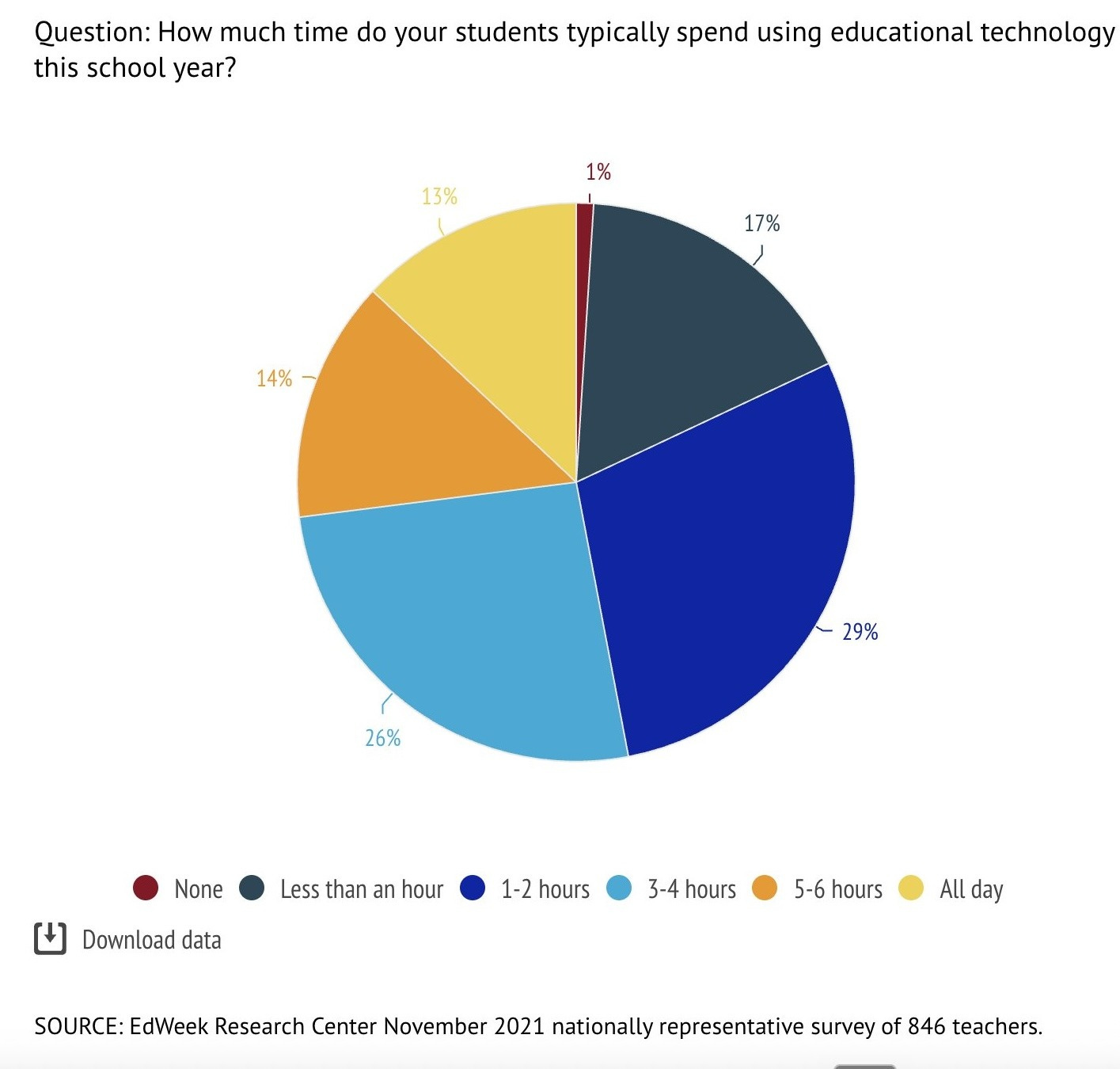
The difference between Alpha and other schools: they’re being transparent about how much they’ve grounded the education in technology.
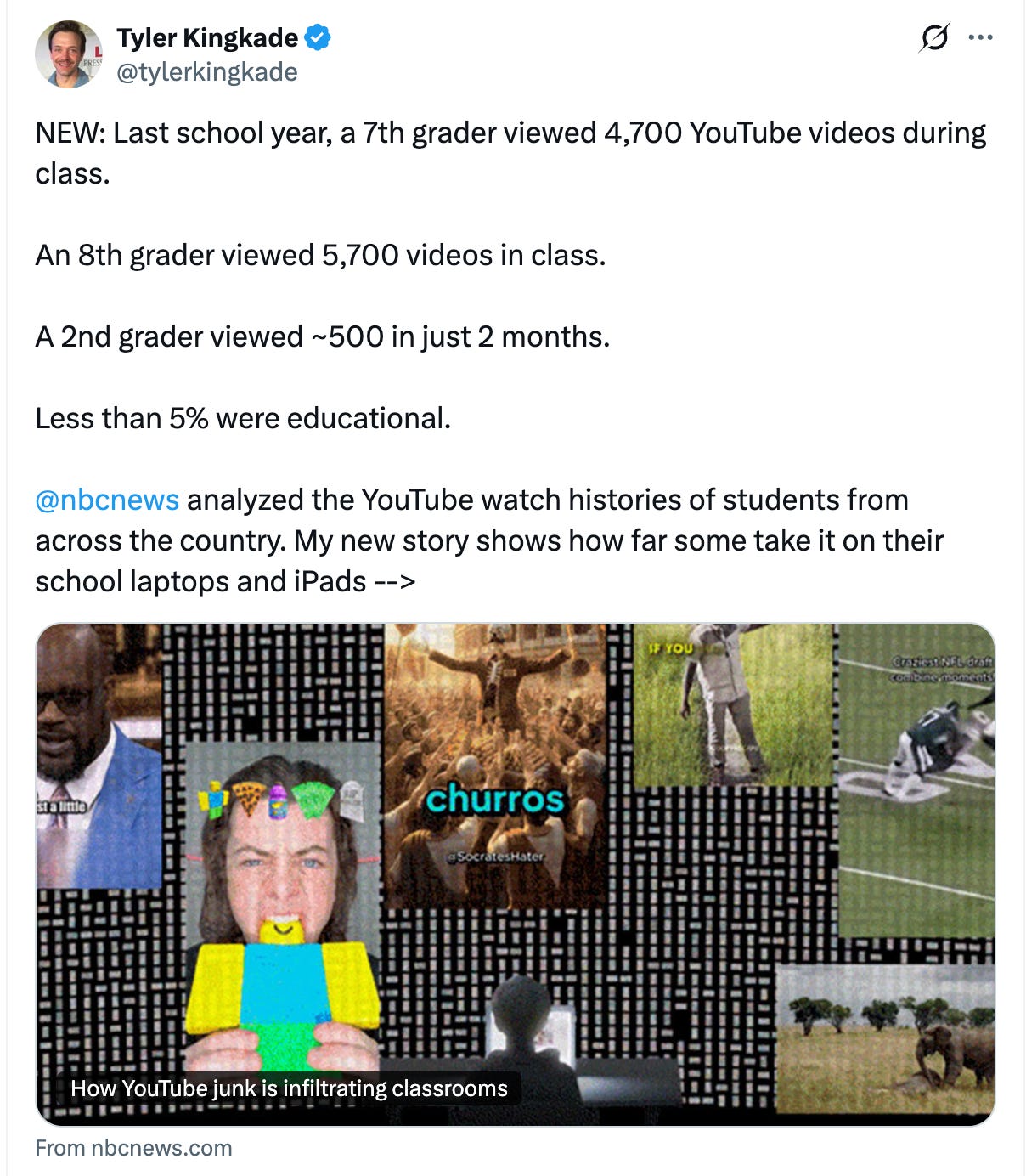
And again, students at Alpha use devices that are locked down via the TimeBack system. They can’t just decide to go surf the internet. Every week, we see horrifying new reporting reminding us that students in public schools are overdosing on YouTube, etc.
Those are just two points of confusion. I’d need a 5,000-word column to begin to correct the broader misconceptions. And as I say above, I’m Learning Science, not Alpha Communications, I’m probably not getting to that column.
Instead, I’m asking everyone to consider that you know very little about what’s happening at Alpha.
After all, you’re probably learning today that an app called Alpha Phonics has been used in Alpha schools since the spring, and I helped to build it, alongside literacy researchers and former teachers.
Please assume there’s more you don’t know about Alpha.
Funny story around Alpha’s approach to instruction.
People who like project-based, student-centered learning cheer Alpha, because students in upper grades have a lot of freedom to pursue their own academic and personal development paths. When I told my mom, a career educator, about Alpha, this was her favorite detail.
At the same time, people who know Carl Hendrick and Zach Groshell joined Alpha are encouraged that Alpha is embracing direct instruction.
I have chuckled watching Alpha draw praise from both sides of the Instruction Wars.
In fact, Alpha does have a foot in both camps, as it should. There’s an important role for explicit instruction, especially for more novice learners, and a time and a place for project-based work (hello, high school electives). Good K-12 instruction has never consisted entirely of one of these things, and maybe Alpha can help to model the nuances in these raging debates.
Chapter 1 will be: Adult politics wreck everything.