

Where the ‘Science of Reading’ is concerned, we’re in our Implementation Failure era.
50 states have enacted Science of Reading reforms since 2019. Yet only a few have NAEP reading gains to show in the same period. In fact, many states show declines in reading proficiency over the last decade.
Why is Science of Reading reform translating into reading gains in a few states, yet in other states, it is very much not?
The issue isn’t specific to “Science of Reading” bills. Implementation Failure is also the story for dyslexia legislation.
A recent study “compared trends before and after dyslexia laws were enacted across 47 states, ” and the findings were grim:
“First, more than half of the states with these new laws showed no significant shift in identifying learning disabilities related to reading. Some states identified more students, some fewer, but there was no consistent national pattern.
Second, reading achievement among students identified with learning disabilities often declined, rather than improved, after these laws passed in many states, including Alaska, Maine, Massachusetts, New York, Ohio and West Virginia.”
To the surprise of no one, the report highlights1 Mississippi, Louisiana, and Alabama as bright spots. These Southern Surge states excel on implementation. It’s the only way.
The study offers another reminder that policy alone is not progress. As the authors put it:
“Passing a law doesn’t equal classroom change… Our findings suggest that dyslexia laws often raised awareness about dyslexia and early reading difficulties without fully changing classroom practices.”
The lesson is consistent. Yet it seems we aren’t learning it, based on the current flurry of legislative activity.
So, I’m rounding up a few cautionary tales about the policy track record and the state of state leadership.
The Fifty State Policy Scorecard
A recent analysis from ExcelInEd offers a reality check.
ExcelInEd has been a leading proponent of state reading reforms, particularly Mississippi’s policy playbook. It’s an understandable instinct, given Mississippi remarkable gains in 4th grade reading.
Yet this hasn’t been a consistent recipe for success. Vince Bielski recently reported on the mixed picture:
“In all, ExcelinEd has identified 18 reforms, including dyslexia screening and parental notification of reading problems, that the most successful states have implemented. Given the heavy lift, it’s not surprising that some states have stumbled.
Of the 15 states that adopted most of the 18 policies by 2019, 10 of them outpaced the national average in fourth-grade NAEP reading scores by 2024… but test scores in four of the 15 states declined more than the nation’s did, and Michigan tied, showing the difficulty of implementing the reforms.”
I wondered how this broke down, and I was able to get my hands on the underlying analysis, thanks to Vince and Christy Hovanetz, the Senior Policy Fellow at ExcelinEd:
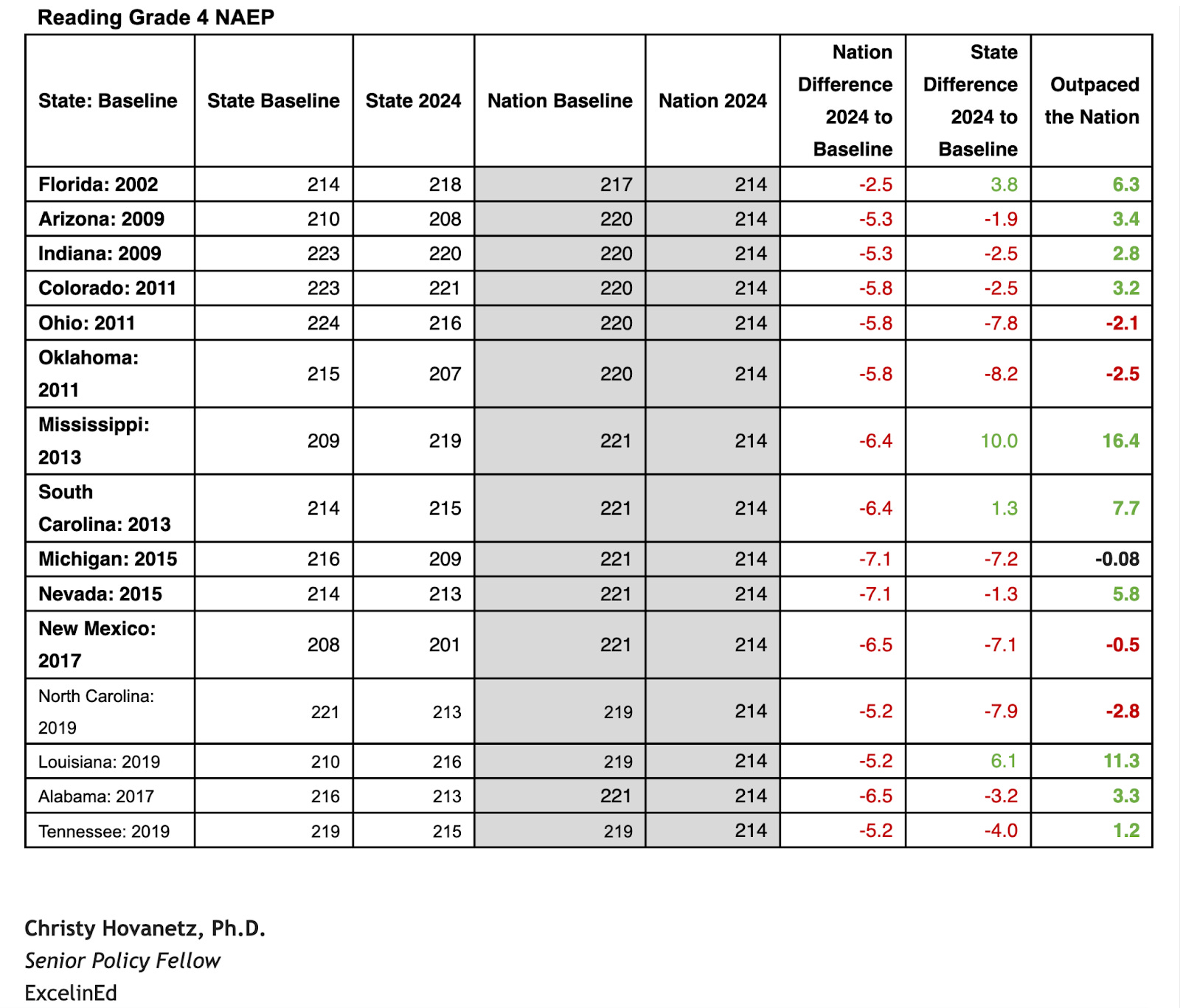
This picture doesn’t serve as a strong endorsement of the ExcelInEd policy prescription, and here’s why:
The Southern Surge states represent 4/10 states that ExcelInEd claims as policy Wins.
Then there’s Florida. It went through a phase with strong leadership and reform efforts, and gains followed. But in recent years, Florida has been the fastest-declining state in the nation overall2, with a meaningful drop in reading:
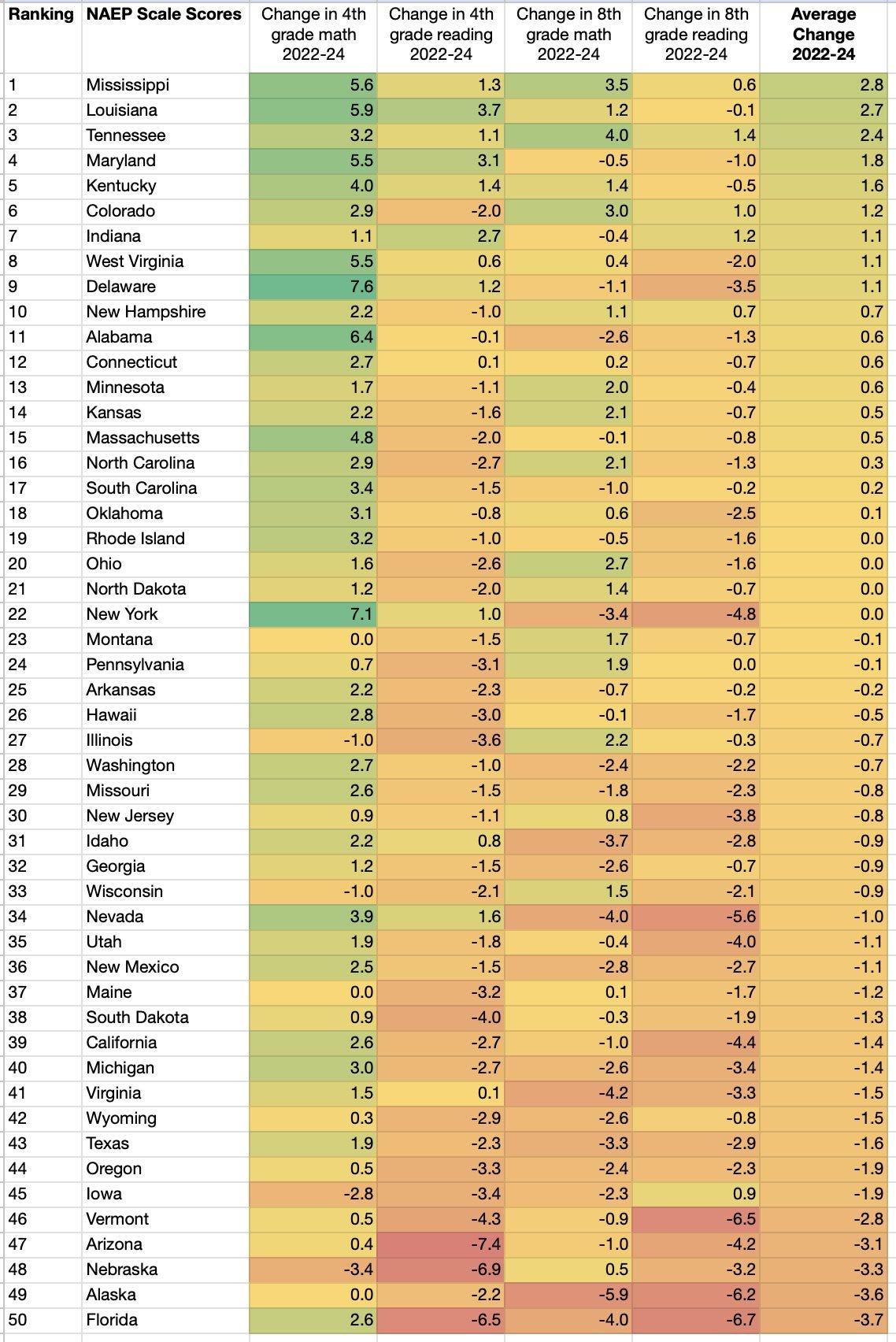
Not exactly the dream reference case, and what’s more, the 2002 “baseline” for Florida in ExcelInEd’s analysis raises its own questions about how we should interpret the influence of a 24-year-old law.
My argument is that implementation is the real leverage point, not policy. Good implementation takes leadership. I see a compelling case that Mississippi, Louisiana, Tennessee, Alabama, and Florida went through chapters when strong leaders truly leaned into strong implementation, and outcomes rose because of well-executed reforms3.
But if we call those states Implementation Stories, and take those five states out of the ExcelInEd data set, we’re left with ten states that passed a big pile of legislation, and only half of them have gains to show for it.
Every legislation booster needs to sit with that.
Leadership > Legislation
My conviction that policy is not the primary driver was shaped by firsthand experience in Southern Surge states.
Between 2018 and 2022, I visited classrooms across Tennessee during the early years of the state’s literacy reforms. I also interviewed educators in dozens of districts specifically about their literacy work. Policy never came up.
I heard a great deal, however, about the state’s role.
In advance of the 2019–20 curriculum adoption cycle, Tennessee leaders convened regional meetings of district leaders to facilitate information-sharing about curriculum and professional learning options. District leaders consistently described these sessions as invaluable.
District leadership can be isolating, and Tennessee’s deliberate efforts to connect leaders across districts sparked important peer-to-peer learning. Educators were debating whether to adopt Tennessee’s new free phonics program or keep their existing curriculum, and how to get teachers to ‘break up’ with practices rooted in Balanced Literacy. Collaboration helped.
The state designed hands-on, proprietary teacher training delivered over two summers that reached more than 90% of teachers. Everyone praised this training and how it reinforced the curriculum work.
State leaders understood that the best outcomes would come from strengthening local capacity, in classrooms and district offices. They intentionally highlighted pioneering districts, to inspire replication elsewhere. The work was thoughtful, practical, and deeply people-centered.
Policy and funding were enabling conditions, of course. But focused implementation—designed around educator needs and capacities—was the fuel in the reform engine.
When I speak with educators in Louisiana and Mississippi, those themes recur.
State Leader Capacity is the Lynchpin
Literacy policies are executed by state chiefs of education — the officials (sometimes called superintendents or commissioners) who lead state education agencies and shape how law and regulation translate into practice.
Leadership experience varies widely, and the role sees a good deal of turnover. For example, Virginia’s chief has changed twice since early 2025.
Ballotopedia tracks the state chiefs nationally. A review shows:
Six chiefs are new in the last 6 months
Five more chiefs are new in the last 12 months
Five more chiefs are new since the beginning of 2025
In sum, a third of state chiefs are new to the position.
Further, many had no previous experience at the state level, and some had no prior education experience. Implementation is compromised when chiefs are learning on the job.
The role itself has also become more political. In many states, debates over school choice, funding, and culture-war issues dominate K-12 discourse, often pushing classroom practice and literacy implementation into the background.
In addition, some state agencies approach their role primarily as funding distributors, cheerleaders, or compliance monitors, rather than as drivers of implementation quality. As one well-connected policy advisor describes it:
‘When I ask, “OK, you passed these laws, how many districts changed?,” nobody can answer the question.’
Policy can compel action, but it can’t ensure quality execution.
When writing on the Southern Surge, I’ve emphasized the role of savvy leadership. In Mississippi, Carey Wright deployed state literacy coaches into underperforming schools and did so without triggering backlash. In Louisiana, John White and Kunjan Narechania rebuilt state systems to incentivize high-quality curriculum work, Rebecca Kockler designed the first curriculum review process of the Common Core era, and Whitney Whealdon authored a superb homegrown ELA curriculum. In Tennessee, Penny Schwinn and Lisa Coons architected the curriculum and training work described earlier.
These examples are not accidents. They are evidence of what strong state implementation leadership can accomplish.
Critically, there isn’t a strong, routine national framework holding chiefs accountable for implementation quality. At the federal level, the mantra has been “power back to the states,” but zero incentives or accountability mechanisms are tied directly to how well state agencies execute reforms.
This opacity is unfortunate, because when you really get into the weeds of reform efforts, the difference in execution becomes impossible to ignore.
In the next installment, I’ll look at how these differences play out in practice. Stay tuned for Part II.
Related Reading: a few weeks after I published, a new reort from Fordham added fresh new evidence to the case.
Also, this short spotlight on Tennessee’s track record offers a nice contrast. People-centered programs > Policy, all day long.
Same Hymn, Different Pews
You don’t have to take it from me. Rick Hess recently published a cautionary piece on Southern Surge replication, and we’re singing from the same hymnal.
Here is Rick’s straight talk:
“Policy is a blunt tool that works best when compelling action is enough. That’s why policy works reasonably well if the task is issuing Social Security checks or setting noise ordinances. It’s much shakier when the action is more nuanced, like changes in instruction, curriculum, or classroom culture. The failure to appreciate this has tripped up a slew of seemingly sensible reforms, from teacher evaluation to school turnarounds.
In education, bets on policy are safest when dealing with “musts” and “must nots,” as with things like compulsory attendance, annual assessments, class size limits, and graduation requirements. These tend to be clear-cut and quantifiable. If you want to require that school choice programs get funded, or that high schools offer career apprenticeships, there’s no substitute for policy.
Policy is far less reliable when it aims for complex endeavors concerned more with how things are done than whether they are. Compulsory attendance doesn’t mean students will learn anything. Funding a choice program doesn’t mean it will be accessible or competently managed. High schools can “offer” apprenticeship programs without providing meaningful placements or supervision.
Again: Policy can’t make people do things wisely or well. And, in education, it’s usually the quality of the thing that matters most—as with teacher evaluation, school improvement, or reading instruction. Equipped with only the blunt instrument of policy, though, public officials face enormous pressure to make the world a better place.”
I take one exception with Rick’s piece: he suggests that Mississippi and Louisiana have both implemented effective curriculum reforms, when in fact, Mississippi has failed to bring knowledge-building curriculum into statewide use (while Louisiana succeeded). I’m always surprised how few EdReformers realize this, when it’s a) important, and b) contributes to Mississippi’s struggles to realize 8th grade gains.
None the less, it’s an excellent read overall.
Coming Attractions
Next week, I’m excited to moderate the Southern Surge panel at ASU+GSV. What do you want to hear from these leaders? Let me know in the comments.

From the report on dyslexia legislation:
“Mississippi is often cited as an example of a state that successfully paired dyslexia policy with a broader overhaul of reading instruction, resulting in a boost in reading achievement scores from 2013 to 2019. This overhaul included more structured reading instruction, teacher training and literacy coaches in schools.
Other states, including Louisianaand Alabama, adopted similar approaches and also saw reading gains for kids with learning disabilities – including dyslexia – after they enacted their dyslexia laws.”
Public thanks to Marc Porter Magee for surfacing this data, and the chart I reference, regularly in social media.
To be fair, we don’t ever have a perfect window into causation for NAEP shifts, but I stand by my prior read of the trends in the Southern Surge states, and how reading scores moved following multilayered reading reforms.
Education really is the classic case of “policy is not progress.”
The real work happens in the space between the statute and the classroom. That gap is where implementation, local capacity, and trust either compound into progress or kill good policy.
Coming from a world where we think a lot about institutions and state-level legitimacy, I’d add one layer: local context as a precondition for durable change. If a reform, however evidence-based, doesn’t speak to the lived reality of a state’s communities, its workforce needs, its culture, and its political rhythms, it will never earn the kind of broad coalition that can defend and sustain it - evidenced by leadership galvanizing deliberately in support.
In that sense, education really is “hyper‑local” at the point of contact, but it still has to be nested in a shared initiative/project that makes sense at the state level. The best plays I’ve seen pair non‑negotiable, research‑grounded practices (especially in early literacy) with a serious effort to co‑design the how with local educators, families, and civic leaders. That’s where you get both fidelity and buy‑in.
Have to treat implementation as a political and relational project, not just a technical one: build state-level consensus around the “why,” then invest deeply in local context so communities can see the work as theirs, not something being done to them.
Your elaboration of Tennessee's people-first approach gives me hope while digesting a sobering analysis (also, ugh NY's math data). It's the water cooler conversations that quietly make impact — the mundanity of people coming together, living with messy friction, and deciding they need each other to be better. That proximity and productive restlessness is the magic. You make it sound like the leaders at the helm in Tennessee recognized it's the teachers who would most benefit from the support — and that's rarely where the money goes. And I reading that right?
I see something similar at the classroom level. Curricula rely on high teacher capacity but often make assumptions about what knowledge teachers already possess — without naming those assumptions — and then leave it to teachers to fill gaps they didn't create.
Are there longitudinal studies that actually examine investment in capacity building and its impact on student outcomes?