

A reader described this newsletter as a “full meal deal of all the things” (which may become its new tag line).
This week, it’s a seven-course belt-buster.
I’m also introducing a new feature: my hot takes in the footnotes! You’re welcome.
On Center Stage
It’s Legislation Season, and Kareem Weaver and Brett Tingley were among the advocates in Washington this week, to advance a Senate bill that would tighten the criteria for state literacy grants. Love the bipartisan vibes!
BUT, I’m bummed that none of the legislation advances the most impactful ideas: a new National Reading Panel and a national curriculum usage database. Can we change this before the bills ship?
Two good columns dropped on the Southern Surge. While I welcome the enthusiasm, I still sweat the subtexts:
First, in How Democrats Lost the Plot on Schools—and How to Get It Back, Charles Barone noted the political rebalancing around reading reform. He’s right, and it’s a laudable trend!
However, Barone praised some states with real implementation shortcomings—a reminder that we need to peel back the onion on state-by-state implementation. (More on that in the footnotes1.)
Second: to understand why I worry about surface-level Southern Surge discourse, read this column in Real Clear Education. It trumpets a “legislative solution” to our “reading crisis” that’s as simple as one state’s Literacy-Based Promotion Act.
Policy (alone) isn’t progress, y’all. It’s time to shout it from the hilltops.
Knowledge, So Hot Right Now
This week’s must-read was a slam dunk case for knowledge-building curriculum from Dan Willingham and E.D. Hirsch.
Natalie Wexler served up an excellent “non-example”, explaining how and why Benchmark Advance is not, in fact, a knowledge-building program. Don’t miss the mind-blowing footnotes.
Laura Patranella detailed similar shortcomings for Into Reading. Same Issues, Different Basal.
Olivia Mullins is working on a framework for explicit elementary science instruction.
Bring Back Books
Doug Lemov and Kyair Butts headlined a recent webinar on how to teach whole books. <swoon>
I think we need to capture the differential volume of reading in book-rich programs versus basals. Here’s a glimpse into that dichotomy (and a preview of things to come):

The Literacy Zeitgeist
Oral language development is all about practice, and this video of Anajette McNeely’s Kindergarten oracy routine is worth your time.
Carl Hendrick on the “orthographic skeleton” will expand your thinking on the connection between vocabulary and reading ability.
“Meeting a standard is only approximating learning,” says Whitney Whealdon in The Problem With Standards.
Laura Stam also shared classroom video, showcasing routines that create response opportunities for all students.
Samantha Lippert is on Week 5 of a fluency intervention. Follow along in her data.
Learning on Learning
Ben Zulauf explains how differentiation-done-wrong backfires for weaker students. Don’t miss the fascinating study on teacher expectations.
SOL in the Wild makes the case. that offering students choice is a misguided vestige of learning styles.
Sarah Oberle and Mitch Weathers have a new book on executive functions in elementary. I really enjoyed their podcast insights.
Ed Tech Backlash Watch
The teachers at the Curriculum Insight Project are Ready to Break Up With iReady, for good reasons.
Chalkbeat delivered a timely story: “This school district gave teachers one week to get rid of screens” Its superintendent heard that reading in K-5 had “almost vanished.” Devices were banned “almost overnight.”
Parents in Lower Merion, an affluent Philadelphia suburb, want to opt out of Ed Tech. The district won’t let them.
Matt Yglesias penned a smart piece on the Ed Tech backlash. I agreed with much of it, but I’m not sold on the Accountability Theory (more in footnotes2).
Help a Researcher Out
Boston University is recruiting participants for a study of different tutoring modalities. From Megan Gierka: “The study is open to first and second grade students in the U.S. who speak English. Participation is remote (with optional in-person implementation).”

Coming Attractions
April 9: Sean Morrisey presents on cracking the code in academic vocabulary with the Reading League Illinois.
April 16-18: Learning and the Brain is live from New York and available virtually. Hear Dan Willingham, Natalie Wexler, Sarah Oberle, Leslie Laud, ++.
Join me at ResearchEd NYC on May 2nd!
ResearchEd St. Louis is coming in September. Apply to speak by 5/15.
Beyond the Edusphere:
“Holding hands with a loved one reduces pain via increased brain-to-brain coupling.”
Next weekend, this newsletter is taking a hiatus. I’ll be resurrecting must-read favorites from the last few years (Easter pun intended). Nominate a story.
Thanks for reading! Nominate a story for this newsletter here.
This is my favorite section of Charles Barone‘s piece on how the Democrats lost their way on education:
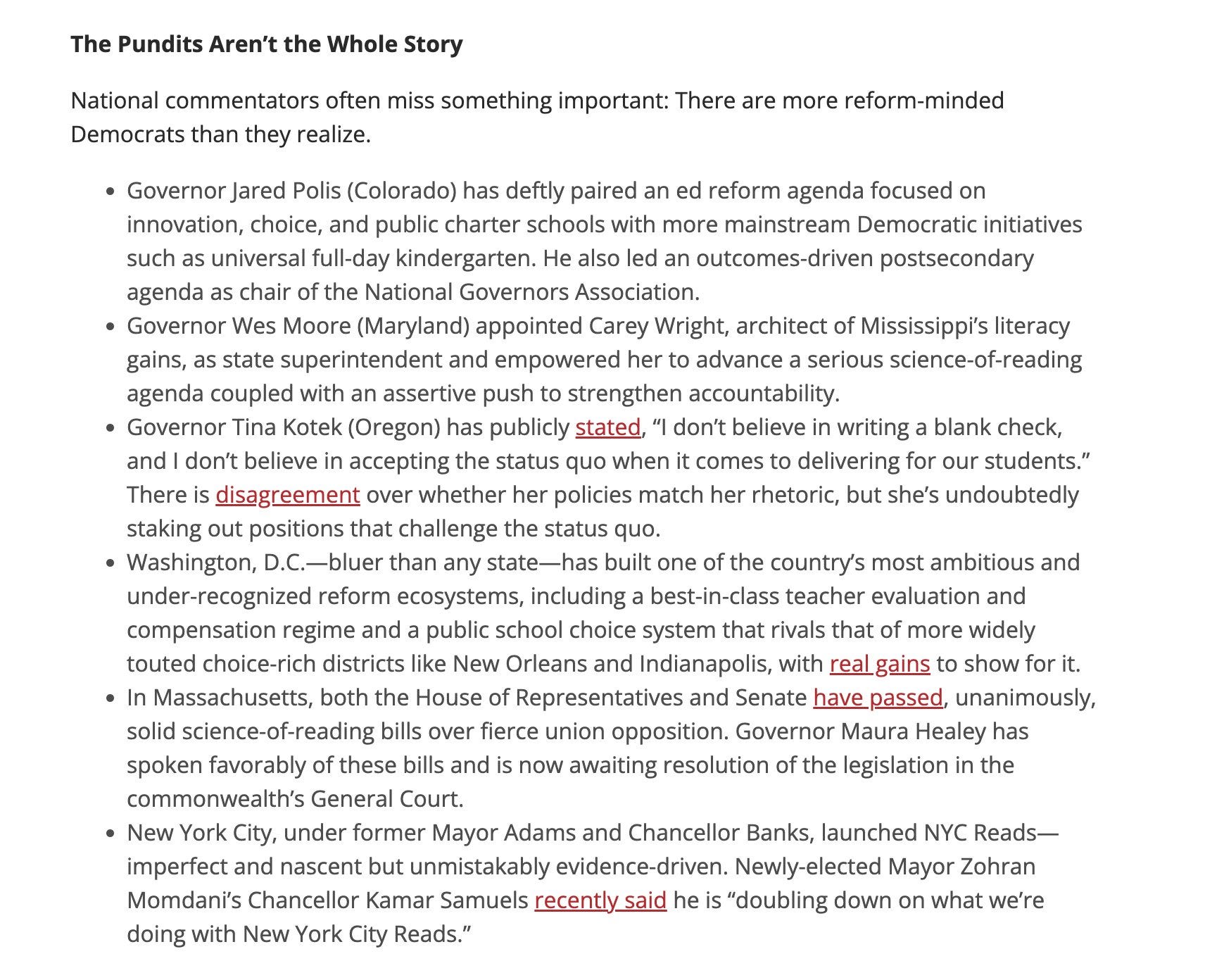
Yet this section illustrates the limitations of using politics/policy as a barometer for anything.
Barone is right: there are reformers on this list. Dem reformers! And there is a lot of forward progress, too.
BUT... the devil in the details matters, and many of these wannabe reformers have implementation issues holding back their progress.
For example:
- Colorado has mediocre curriculum in many districts thanks to a flawed state list.
On the NAEP, Colorado’s 4th grade reading proficiency is down relative to 2019, and dropped again 2022 to 2024.
- Oregon has a Dept of Ed that likes to dole out $$ and is practically allergic to accountability. Oregon district leaders say this about its Science of Reading reforms.
On the NAEP, Oregon’s reading outcomes have tanked since the 2010’s, and it’s down relative to peers and the national average.
There are bright spots in Oregon. Portland instituted district-level reforms that look like... wait for it... Louisiana’s and Tennessee’s! Two years into work with new book-rich, knowledge-building curriculum, the district is seeing small gains on the state assessment. You never see this detail in national media (nor Baltimore’s somewhat-comparable story).
- In NYC, the reading initiative is well-intentioned and broadly well-structured, but the district let one crummy curriculum onto its allowable list and most schools picked it. Parents and teachers both dislike it, and if Samuels did one thing, he should consider replacing it, so all choices are of higher quality.
Policy isn’t progress, folks. “Reformer mindset” does not translate to reading gains.
For clarity, I don’t fault Barone for not including this detail.
Very little in the media-and-edreform ecosystem is surfacing these granular, execution-level details... so the conversation stays at the “pundit level”. Witness allll the people shouting that Mississippi “just did phonics” and magic happened.
We need to find a way to get more clarity on the finer details that distinguish MS/LA/TN/AL’s execution (not just their policies), or the follow-the-Southern-Surge era will disappoint.
And politicians will continue to get participation trophies for their eloquence, when what we really need is execution.
My hot take on Matt’s post and the Accountability Thesis (that the rise of crummy Ed Tech was an outgrowth of weakened accountability in the last decade-plus):
It’s a smart post, especially the part about the Ed Tech backlash being a symptom, not necessarily THE malady. I say that as someone with an anti-Ed Tech bent, because most of the first-generation Ed Tech was well-marketed garbage.
I’d classify this moment as a backlash against Stuff That Didn’t Work (including but not exclusive to Ed Tech), witnessing the revolt against Balanced Literacy curricula... which is now being followed by a backlash against overly-conceptual-and-discourse-oriented math curricula, overly-complex phonics curricula, oral-only phonemic awareness programs, and I-could-go-on.
Mind you, iReady is not a good tool for instruction! We just published a piece on the issues over at the Curriculum Insight Project.
As important as it is to root out things that don’t work (whether it’s Ed Tech or a flawed curriculum), the equally-important question is: What are schools supposed to replace it with?
Which brings me to my concern about the accountability-can-fix-it thesis.
The accountability theory of change assumes that schools know what to do to raise outcomes, and if we just put the right carrots or sticks in place, they will do it. I don’t actually believe that’s the case, writ large. The embrace of crummy programs is a symptom of an education ecosystem where educators receive (and often believe) loads of misguided signals about what works to improve outcomes.
Put another way: if we implemented new accountability schema today, paranoid schools would be just as (or more) likely to embrace the next faddish tech-enabled solution (“just like iReady, untested for efficacy, but now AI-enabled so it’ll work this time!”) as they would to embrace the curricula in Louisiana and Tennessee. Ask me how I know.
So, I think we need to go upstream with accountability, and look at Accountability at the Input Level, or at least better research/insight, so we give better signals to schools (and school boards and parents) about the quality inputs/programs.
There can be a role for policy here. I like the idea of a national curriculum database, so we can do research into what schools are using and correlations with performance.
More to say on how we can kick accountability upstream, but that’s probably its own post.
Thanks for the time & effort you put in, to keep us all up to date… its terrific. <swoon>
Thanks for the shout out! I love reading this each week.