

The Great Ed Tech backlash spanned The New York Times, Wall Street Journal, The New Yorker, and the Boston Globe. Wowza.
Fortunately, it was a big week in literacy, too. Plus math and science!
On Center Stage
A new Fordham study reported on the prevalence of cueing in US classrooms, so naturally, everyone was riveted.
Andy Rotherham used the study as a reminder that Science of Reading implementation is all over the map, and we need to call balls and strikes honestly.
My take echoed Andy. I also noticed an important disconnect: the Fordham report calls for states to mandate curriculum lists. But it fails to recognize how poorly state curriculum lists align with Science of Reading goals… even as the calls are coming from inside the Fordham report.
The National Tea
Louisiana Senator Bill Cassidy has been leading the effort to pass a national literacy bill, but he is staring down a close primary election.
Literacy researchers seek a more nuanced discussion of the Southern Surge.
Arne Duncan thinks the left is “adrift” on education.
The Atlantic explains how New York City’s education budget became “an untouchable money pit.” It’s a heckuva read.
The Literacy Zeitgeist
A new study from Megan Gierka et al raises an inspiring question: What if a 3-minute task could flag students with DLD?
California and Michigan recently rejected iReady as a literacy screener, due to a number of seldom-discussed limitations.
Brett Benson slays sentences: How Sentence-Level Instruction Is Transforming Writing in My Classroom
Chris Such shares an intriguing reading map while lamenting common pitfalls: too little time on text and surface-level text discussions. British schools, they’re just like us.
Sean Morrisey joined Substack by dropping a morphology matrix, because of course he did.
Curriculum Chatter
Two Washington districts—Seattle and high-performing Lake Washington—both adopted the digitally-delivered Emerge reading curriculum (“Wonders, but make it Ed Tech”). As with Wonders, Tim Shanahan was a key architect, and Emerge seems to have inherited the Wonders DNA: no whole books and limited knowledge-building. The Seattle Times says it’s “the first time Seattle Public Schools’ core instructional materials officially embrace the science of reading.” SMH.
EdReports released its first reviews of PreK curriculum. Much to the chagrin of the literacy community, the unstructured and knowledge-lite Creative Curriculum earned reviews on par with better options. Heavy Sigh.
Student Achievement Partners released new PreK instructional materials guidelines, as well as guiding principles for middle school.
Math and Science Wars
Holly Korbey raised hard questions about “productive struggle” in math. Why so little focus on math fact fluency? This quote from Bill McCallum, lead author of the Common Core in Math, will certainly cause conversation:
‘“Common Core is very clear: know your addition facts by the end of grade two, know your multiplication facts by the end of grade three, then later on, you have to be fluent with the standard algorithm for addition, fluent with the standard algorithm for multiplication. It’s as unambiguous as it can be,” McCallum said. He mentioned the importance of putting math facts into long-term memory to make working new problems easier.’
CRPE has a new report on the Math Wars, calling for action to address the confusion.
A new British study validates math tracking in upper grades, suggesting it benefits top students without hampering progress of lower-performing students.
Olivia Mullins asks excellent, pointed questions about the Next Generation Science Standards.
Learning on Learning
Carl Hendrick shares lessons on retrieval practice: the ability to recall a rule does not ensure the ability to apply it, according to new studies. I spy implications for the over-complicating phonics conversation.
Laura Stam rounds up reading on Behavior.
Nature Is Healing?
Dallas schools banned phones. A year later, they report a 24% increase in library book checkouts. People loved this story; my tweet about it had 1.2 million views (!).
Hechinger Report featured tricks teachers are trying to fix students’ shortening attention spans. It’s good to see this covered, but hoo boy, I cringed about the superintendent encouraging “edutainment” to increase attention spans. Irony Alert.
Ed Tech Backlash Watch
Another week, another deluge:
In The New York Times: In Backlash Against Tech in Schools, Parents Are Winning Rollbacks
The Wall Street Journal published a detailed expose on the misuse of YouTube in schools. It’s my nominee for must-read of the week.
Jill Filipovic seemed to think so, too. She pulled numerous details from the WSJ article into a missive: We Have to Get AI and Screens Out of Schools and Out of Kids’ Hands.
Filipovic also sampled Jessica Winter’s fierce piece in the New Yorker: “What will it take to get AI out of schools?”
The Boston Globe reported on the “anti-Chromebook movement sweeping schools.” This detail killed me: “Northampton elementary school parents are worried about the use of YouTube videos in place of teacher-led story time.” Gah.
Vermont legislation is brewing. The tracker for state screen time bills is up to 20 states.
Honestly, I can hardly keep up.
Quote of the Week
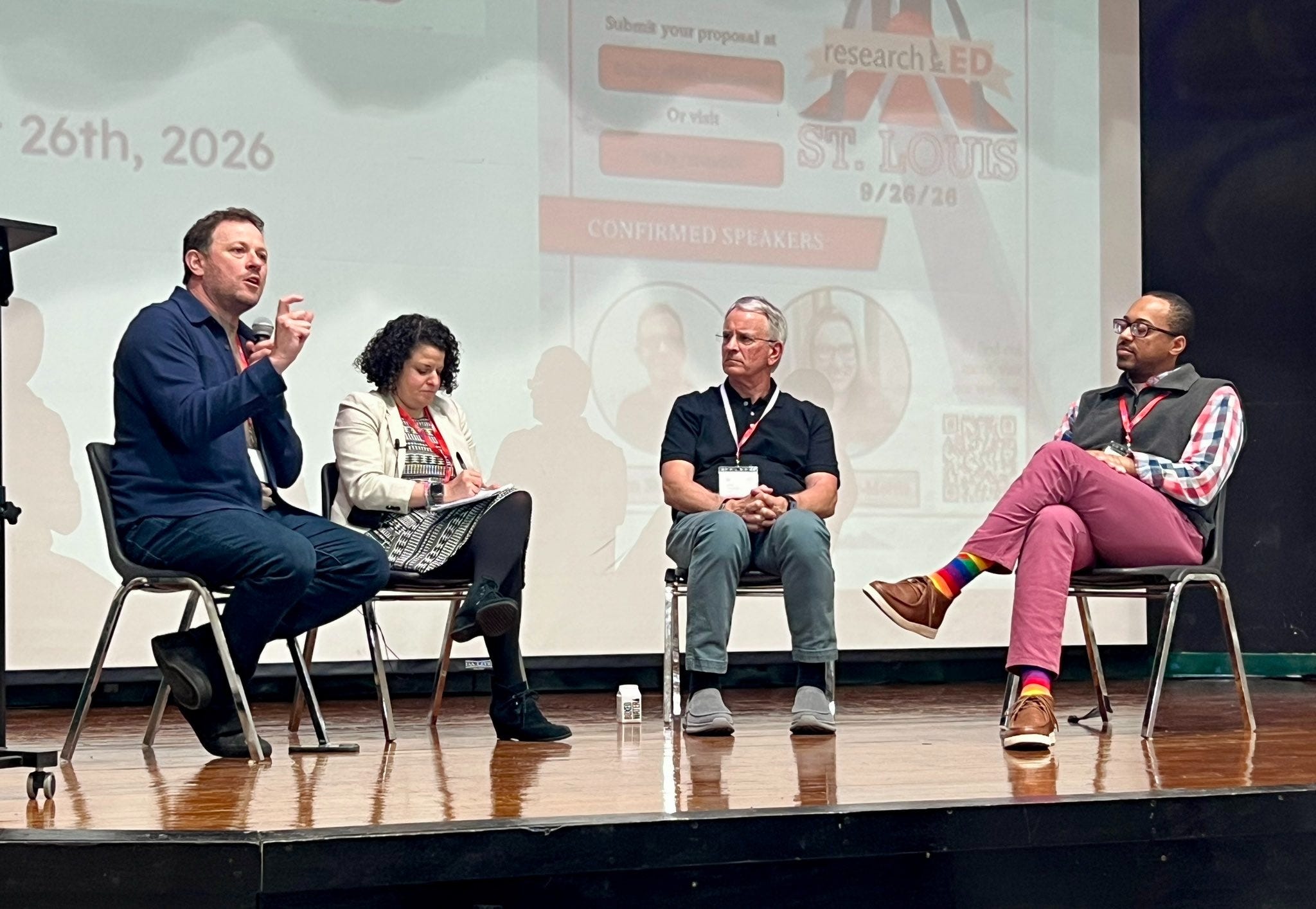
Jim Heal at ResearchEd New York City: “Learning science in this country is still growing up. It’s probably a teenager.”
The crowd chuckled… and some encouraged him to revise it down to toddlerhood.
Coming Attractions
May 16: Read Washington hosts A Conversation with Dr. Jan Hasbrouck about Comprehension & Fluency
June 30th: the Teaching That Succeeds symposium.
September 26: ResearchEd St. Louis. Apply to speak by 5/15.
October 24: ResearchEd Toronto.
Coming off an amazing ResearchEd in New York City yesterday, I hope you’ll consider the last two events!


A Word About The Social Airwaves
This week, the Curriculum Insight Project, our grassroots effort to raise awareness of curriculum issues, crossed 5,000 subscribers here in Substack. Holla! It also boasts 6.9K followers.
In Twitter, the Curriculum Insight Project has 2.6K followers.
I can’t think of better evidence for the waning of EduTwitter, as wel as the importance of Substack as the replacement learning space.
I also never thought Education LinkedIn would be a Thing, but here we are. The literacy community is especially active there.
Thank you to everyone reading and sharing here.
Beyond the Edusphere
If you haven’t watched the Yung Lean video that broke the internet, it’s a Must for its transcendent choreography. Skip to 4:17 for the visual feast.
This substack is always a great read, but this particular one is a bonanza of valuable resources.
The Fordham Study on policy vs implementation, iReady's quality as a screener, Holly Korby's "Math Wars" article, and more -- all filled with valuable data!
Thank you!!!