


An important "Science of Reading Progress Report" just dropped from Fordham.
It’s full of lessons on the state of reading instruction. I’ll start with the ones that people aren’t (yet) talking about.
Curriculum Matters
Curriculum advocates encourage the use of curricula which are “educative,” meaning they incorporate professional learning for teachers, and/or model good practice so effectively through their design that teachers learn through their use.
The report offers a proof point:
“Encouragingly, the survey data show that teachers who use UFLI tend to know more about the science of reading than the rest of the sample, as do teachers using CKLA-Amplify. In contrast, teachers who use Benchmark, Fountas and Pinnell, and i-Ready (the nation’s second most popular reading curriculum) tend to be less knowledgeable than their peers.”
Good stuff!
However…
State Lists Are Missing the Mark
Fordham’s report carries this insight into its recommendations. It calls to “require districts to choose a science of reading–aligned curriculum from a state-approved list in grades K–3.”
Yet the report fails to mention (or grasp?) the disconnect between its observations about curriculum quality and the reality of state lists.
For starters: Fordham’s report implicitly cheers UFLI for its educative nature. Well, UFLI has faced many challenges getting onto state lists.
In addition, Benchmark Advance, which is called out by Fordham for its “unscientific methods,” is on numerous state lists, including Colorado, Virginia, and Ohio.
Benchmark Advance is one of the top curricula in Georgia, aided by Georgia’s state list:
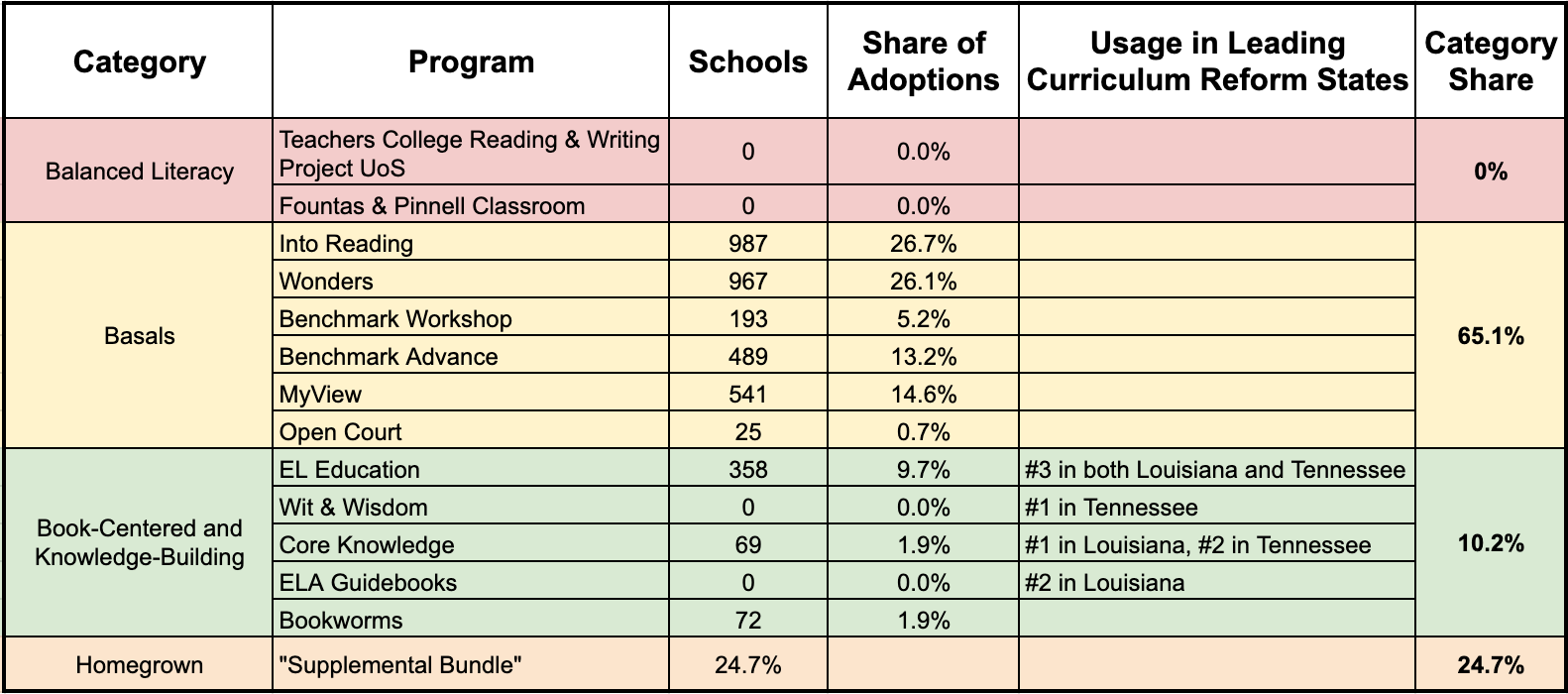
The state embrace of flawed programs traces back to EdReports, the heavyweight curriculum review organization that has been widely under-fire… yet states keep follwing its recommendations like lemmings.
If reformers are going to call for mandates related to state lists, they also need to call for cleanups to said lists.
Unfortunately, the EdReform community is missing the magnitude of the issues with state lists… or they are giving a pass to state leaders. The field’s reluctance to call balls and strikes fairly may continue to hinder progress.
Cueing Has Deep Roots
If the Science of Reading movement came with one message, it was “stop cueing.” In fact, I would be the first to say that other aspects of reading research have been lost in a conversation about phonics and cueing.
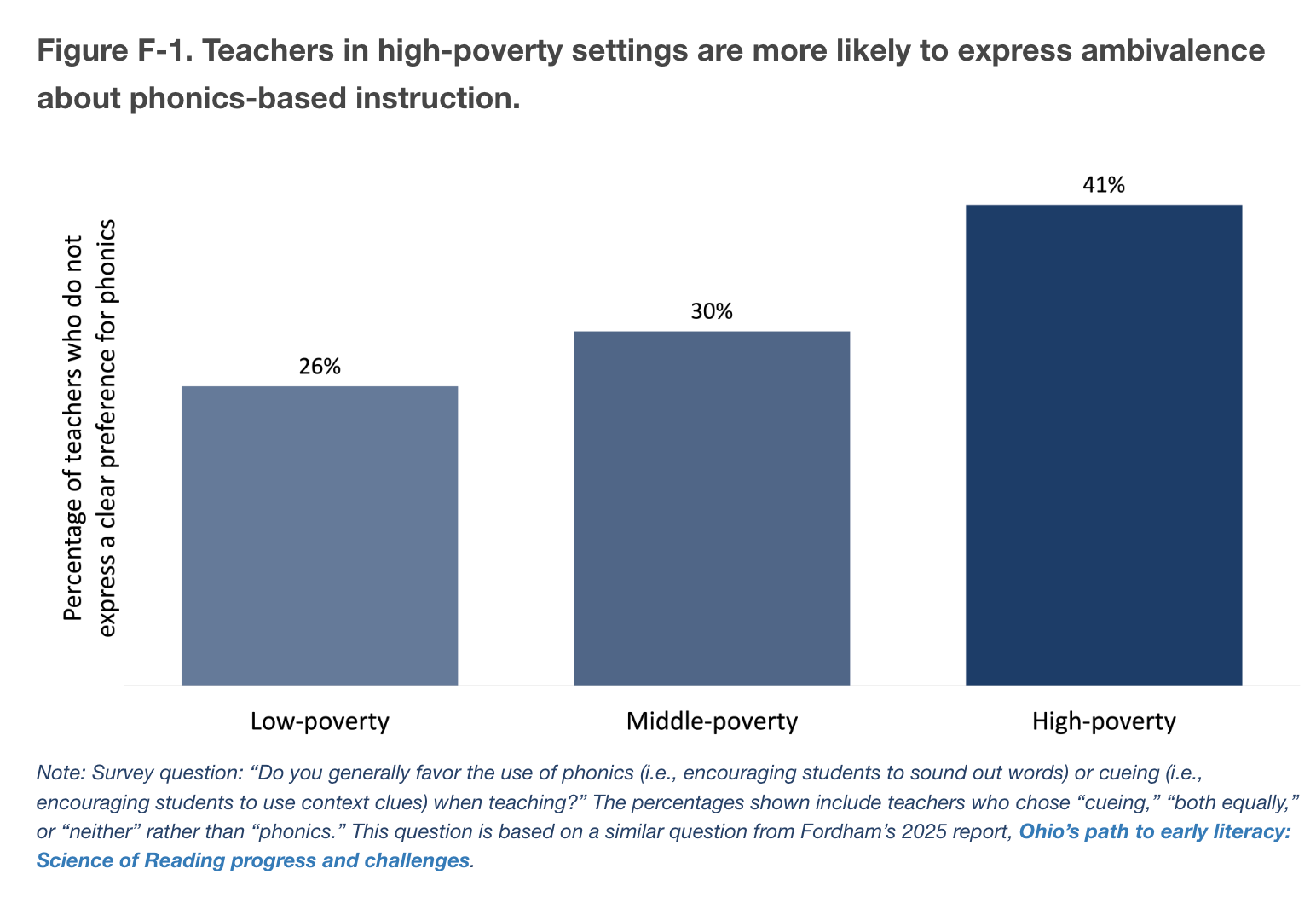
Here’s the part of the Fordham report everyone was talking about, and rightly so. Cueing is the horror movie zombie that won’t die:
Whew.
Think about all of the forces that have conspired to discourage cueing:
Emily Hanford produced multiple podcasts explaining to their harms, starting in 2019. The latest, Sold a Story, became the second most-shared podcast on Apple podcasts in the year it released.
Lucy Calkins, cast as the villain in Sold a Story, herself renounced cueing within those podcasts.
Seventeen states, including Florida, Indiana, North Carolina, Ohio, South Carolina, Texas, West Virginia, Wisconsin, and Missouri, passed some form of a ban on cueing.
Every state took action, via legislation and/or state programming, to reinforce the essential message: phonics was in, cueing was out.
But cueing lives on, with surprisingly deep roots.
The Fordham report adds to the evidence that Policy Does Not Equal Progress, because if policy had carried the day, cueing would be long-gone. A few weeks ago, I collected other really important evidence. Add this report to the pile.
It is simply very hard to change the way that 2% of American workers1 do their jobs. Success comes with multilayered, multiyear, people-centered efforts. In other words, it’s the implementation, stupid.
Lastly, the Fordham report offers a pointed reminder that reading instruction is all over the map—today and every day. Categorical statements about what “schools are doing” are always overstatements. Some US schools are overdoing some aspects of phonics instruction, and other schools are still allowing cueing. And everything in-between.
Surveys like Fordham’s offer a valuable window into the patchwork of American reading instruction. I hope we see more of them, and build resources like a National Curriculum Database, to take opacity out of the system.
Same Hymn, Different Pew
Smart policy folks have been sounding the same cautionary notes about patchy state reforms.
“Today, lots of states are doing “science of reading” but they may not be doing Science of Reading. It’s more than phonics. It can’t be challenge by choice for schools or teachers. It requires a comprehensive set of supports and a commitment to knowledge-rich curriculum and teaching. What Mississippi did and what California now says it’s doing in the name of Science of Reading are not the same thing.”
Andy wants reformers on the left to be willing to call out Newsom on California’s lagging literacy reforms. I want reformers on the right to be willing to say plainly that knowledge-building curricula face obstacles in state departments, including those in red states. Frankly, including Mississippi. Andy and I are both right.
The question of the hour: how do we get more state leaders to move beyond the the Policy Equals Progress mindset, and into these implementation weeds? Don’t miss the consensus here: Rick Hess has been singing from the same hymnal.
Related Reading
Don’t miss Natalie Wexler and Olivia Mullins explaining the shortcomings of Benchmark Advance, where knowledge-building is concerned.
Laura Patranella has explained the same issues about Into Reading.
The Curriculum Insight Project has more of these observations about basals coming soon. Because this issue is simply pervasive.
Really, around 2% of American workers are public school teachers.
NCES reports 3.2M full-time teachers compared to 168.8M in the US workforce (source: Bureau of Labor Statistics). That’s 1.9% of the workforce. There are another 500K private school teachers that I haven’t included in my calculations, but I could; public schools have no monopoly on poor reading instruction, noting the historic popularity of Lucy Calkins in private schools.
If you use NCES stats for full- and part-time public schoolteachers, it’s 3.8M teachers, or 2.3% of the US workforce.
No matter how you slice it, there are a LOT of teachers in America, and they make up a large share of the workforce. Most received crummy training on how kids learn to read in American universities, which is its own poorly-addressed layer of the problem.
People are always shocked when I cite these statistics, but they are the heart of the challenges with education reform. You try changing the beliefs and professional practices of 2% of American workers. I bet it won’t be easy – or swift.

I am a teacher in California and just got back from the Dept of Ed training for those appointed to serve as Instructional Materials Reviewers for the 2026 English Language Arts/English Language Development Follow-Up Adoption. This materials adoption is in response to state legislation (AB 1454) from last year requiring evidence-based curricula be used in schools. I am Orton-Gillingham trained and completed LETRS training. The room was full of professionals who felt the weight and opportunity of this moment for students in California.
Hi, Karen. Can you please say more about, "I want reformers on the right to be willing to say plainly that knowledge-building curricula face obstacles in state departments, including those in red states." What are the obstacles in state departments? To what extent do you think they are political?