


Three big developments on the literacy front:
Congressional hearings happening Tuesday
Mark your calendars: the House appropriations committee is holding Science of Reading hearings on Tuesday at 10:30am.
The list of speakers is long on implementation experience, and I’m here for that. Congress should be hearing what it takes to translate research into classroom practice, at scale.
Speakers include:
Holly Lane, the University of Florida Literacy Institute researcher who developed UFLI, a phonics program that has quickly become a national sensation. Holly knows how to get teachers to embrace this work, for sure.
Bonnie Short, Director, Alabama Reading Initiative. Alabama is one of the promising Southern Surge stories, following in Mississippi’s footsteps.
Larry Saulsberry, Director, Teaching and Learning for Literacy at Huntsville City Schools
You can watch it here.
Will Congress take action on literacy? I know one good idea they should consider.
Massachusetts legislators unanimously embrace curriculum mandates
The Massachusetts Senate voted unanimously to introduce curriculum mandates, which also earned full support in the House. Districts will be required to select curricula off a to-be-determined state list.
Notably, the Massachusetts superintendents’ association supported the bill, after opposing a similar bill last year.
We’re still awaiting the shape of the final bill, to see whether provisions like a free state-developed curriculum make the cut1.
I continue to cheer this legislation in Massachusetts, for two reasons. First, the curriculum landscape looks like this2, even after years of efforts by the state to incentivize change:
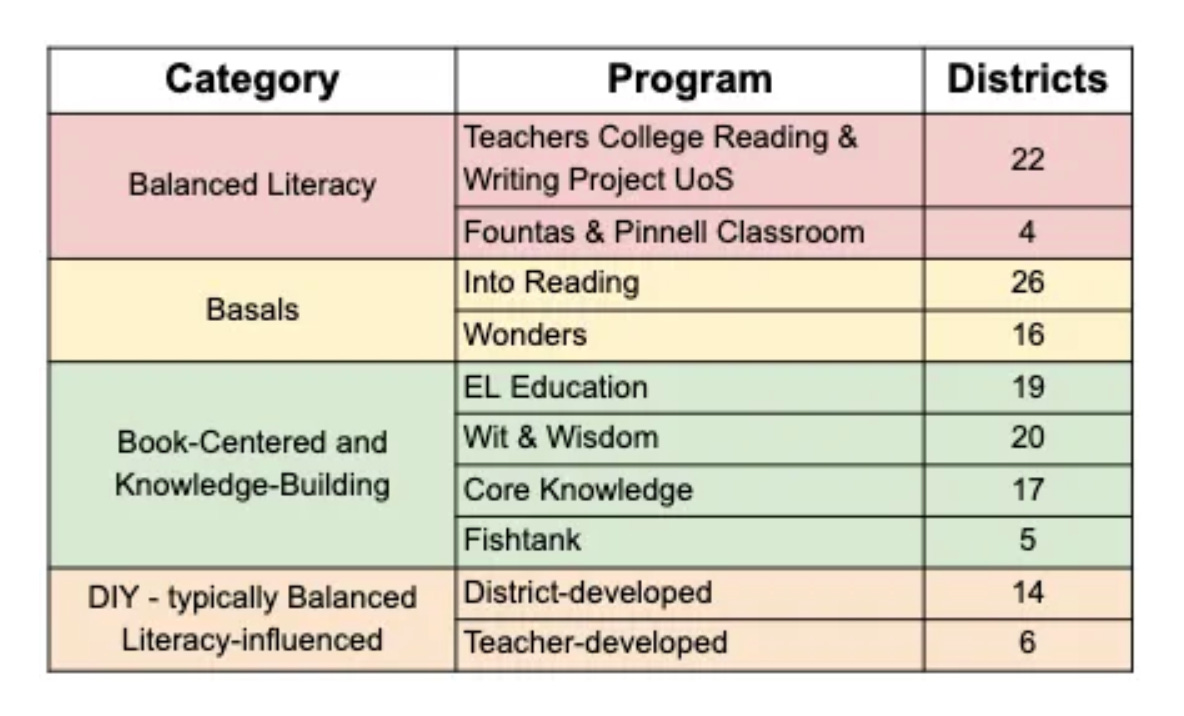
Many Mass districts are irrationally wedded to flawed approaches, and I understand the instinct to force their hand.
Also, Massachusetts leaders are savvy enough to get the list right. I don’t say that in most states, which is why I’m hoping Massachusetts is not a trendsetter with this policy. Most states just aren’t ready for mandates3.
Texas wants to bring back books
Speaking of curriculum mandates, all eyes are on a Texas move to mandate books in the K-12 curriculum. The final book list is still being settled; in particular, it’s unclear how many mandated titles we’ll see per grade.
Generally, the candidates are wonderful books: The Outsiders, Number the Stars, A Wrinkle in Time, Romeo & Juliet, Charlotte’s Web, The Diary of Anne Frank, Because of Winn-Dixie. <swoon>
Part of me cheers this development. I want states to tackle the popularity of book-lite curricula, which have waaaaay too much market share in US schools.
Also, this could represent an opportunity for Texas to pioneer better assessments of reading comprehension. Natalie Wexler just explained that opportunity, while unpacking the pros and cons of Texas’s approach. She’s conflicted, and I’m with her.
Among the concerns: Texas may include religious content, which will surely take an academic opportunity into culture war territory. (Le Sigh.)
Given the complexity, I’d be more in favor of states setting minimum thresholds for the number of books read by students in each grade, with page count and Lexile level expectations. This would help the cream to rise to the top in district curriculum selections.
In any case, a story to watch.
A note about School Yourself:
I’m going to start publishing bite-size posts periodically, to share breaking news with the field. Kind-of like this one, although this post turned into a digest. (So much is happening!)
It’s my reaction to the death spiral my Twitter/X feed. I still post there, but hoo boy, the algorithm has become grim. We lost important conversations when EduTwitter died, and I’d like to bring back the national conversation about breaking news .
As post frequency goes up, please delete rather than unsubscribe, y’all!
My own advice for state leaders on the shape of these provisions can be found here.
As of ~2024. Check out my November writeup of the Massachusetts landscape for more.
I’m a broken record on the reasons, but once more for those in the back: states tend to rely on national curriculum review orgs, and right now, the curriculum review landscape is just plain messy. Also, efficacy data is in short supply (although we could change that).
Love the idea of getting more bite-sized posts with breaking news!
How about looking at Direct Instruction!? 60
Years track record. Google Project Follow
through for More information. What has been proven to work is dismissed because of “feelings” and “preferences”. It’s the kids that matter.