

This newsletter is officially hard to sustain because there is so darned much going on. And everything here is really important.
Stay with me, if you can…
On Center Stage
CNN reports on Columbus hospitals that have begun screening for early literacy issues at age 3, in response to local drops in kindergarten readiness.
Y’all know I’m intrigued by the idea of National Reading Panel, The Sequel, in part because it would allow us to expand the audience for conversations about oral language development and include pediatricians and parents… the only way for 3YO screening to scale.
Speaking of NRP, The Sequel… it’s the #1 idea in Chad Aldeman’s list of five things the federal government could do to take action on literacy.
Chad also continued his series on districts that outperform their demographics. His writeup of Worcester, MD had me screaming “Time. On. Text!!!” I’m certain it’s key to reading success, and it’s the secret sauce in Worcester. The curriculum is built around whole books (Wit & Wisdom). The focused practice in home and school: also whole books.
Hot Topic: Ed Tech Rejection
We don’t dwell enough on the role of ed tech in literacy, given the research showing that reading in a digital format adversely impacts reading comprehension in primary grades.
As such, the growing wave of ed tech rejection should be a friend to the literacy cause.
Signs of shifting sentiment:
Jared Cooney Horvath (author of The Digital Delusion) testified before Congress, and the headlines were fire: “The U.S. spent $30 billion to ditch textbooks for laptops and tablets: The result is the first generation less cognitively capable than their parents.”
Horvath is now on Substack, which is how I learned about the new Tennessee bill that would prohibit digital devices in elementary schools.
Jon Haidt called to get devices out of elementary schools by September.
Kelsey Piper explained why schools “keep losing the technology bet,” with savvy observations about weak research and broken procurement.
An article about the issues with iReady went viral.
Ed tech overuse is the #1 concern of Arlington Public Schools parents in surveys. 60% would opt-out their kids if they could.
Hot Topic: State Curriculum Lists
Mike Petrilli and I discussed the reasons curriculum lists have gone sideways on the Fordham podcast. It’s short, just 18 minutes!
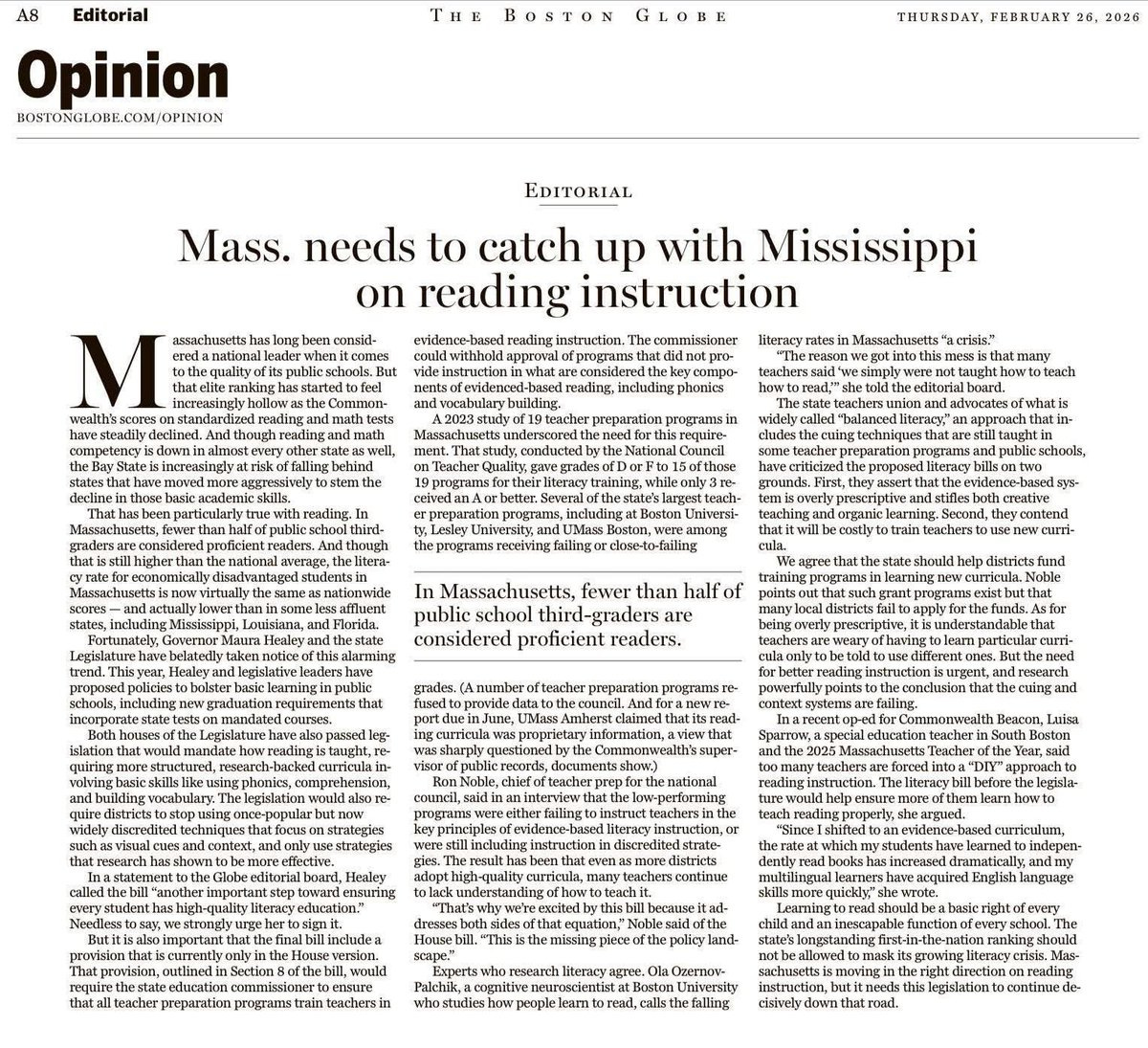
The Boston Globe Editorial Board endorsed the MA bill that would curb local control on curriculum selection, while pushing for teacher prep reforms.
Missy Purcell reminded us how Georgia endorsed iReady over the advice of its own screening committee (!). Georgia, you are a mess.
Hot Topic: Word Mapping Project
When teachers go wild for a teacher-authored supplement—and show wowza outcomes—we should all pay attention.
Sean Morrissey detailed his pioneering vocabulary materials for the Curriculum Insight Project. Elana Gordon is using it too, and happily, her outcomes rival Sean’s.
The Literacy Zeitgeist
Olivia Mullins penned a two-part series on the Benchmark curriculum, showing how its content fails to be cohesive enough to build knowledge for students. A+ work.
Laura Stam, who collects fabulous learning packages for teachers, took on Grammar.
Ben Zulauf confronts the tension between the research on small groups (“they work!”) with the reality that a small group for some students means less teacher time for all of the other students.
New Study: “Reading comprehension & written composition strongly connected in primary grades! And largely explained by shared skills like oral discourse & lexical literacy.”
Dyslexia Discourse
Dyslexia legislation has swept the country, with few signs of improved outcomes for dyslexic students.
Stanford study finds the brain region specialized for recognizing text is smaller or absent in kids with dyslexia, and tutoring can close that neural gap.
3 of the 6 ‘Shark Tank’ investors are dyslexic — and they credit it for their success as entrepreneurs
EduChatter
Does virtual tutoring work? Researchers say: yes, but only when there is a strong curriculum and attention to attendance. It seems best to target early grades, rather than waiting.
Another study shows that parents trust report card grades more than assessments.
Buzzworthy: That Mr. Beast Video
Mr. Beast had a dumb take on reinventing education via videos. Daisy Christodoulou had my favorite retort of many good retorts from the learning science community.
Coming Attractions
AIM’s free symposium on March 2nd has a rich presenter list: Reid Lyon, Linnea Ehri and Hollis Scarborough, Elsa Cárdenas-Hagan, Mark Seidenberg, and more.
Read Washington hosts a conversation with Freddy Hiebert on ways that AI can support vocabulary development. Coming March 21st.
Mark your calendars for ResearchEd NYC on May 2nd. Zaretta Hammond and Nidhi Sachdeva will keynote. I’ll be presenting, and hope to see you!
Beyond the Edusphere
“Addiction to short-form videos reduces brain activity in the frontal lobe weakening the ability to focus.” Welp.
Thanks for reading! Nominate a story for this newsletter here.
Lots to follow! Thank you for creating this gathering.
I was particularly interested in the dyslexia Visual Word Form area study. I wish they had done a reading-age matched design instead. We already know that a child with dyslexia is much less likely to have read as much as a child who is typically developing. And the VWF is likely a reflection of accurate reading practice. It "grows" from usage so the dyslexic brain is likely at a practice disadvantage. So if they are the same age and their VWF is behind, what have we actually learned?
We see that students with deep dyslexia can rapidly learn sound-based decoding with efficient methods, but they then can take inordinately long to convert a repeatedly read word into a sight word, or a word recognized in a blink of an eye. I would love to know more about what brain regions and processes explain that.
Worcester, MD I think you mean :) My pals-worked with them for a couple of years and super proud of their sustained success even through a curriculum switch!