

Coming at you with another overloaded edition.
One week until ResearchEd in NYC! Friends in the northeast, please consider joining me (and Zaretta Hammond, Natalie Wexler, Kristen McQuillan, Zach Groshell, Jim Heal, Meg Lee, Gene Tavernatti, Steve Chiger, +++) at this special event.
Book-Free Reading Curricula
In December, a DC parent published an editorial critiquing the selection of a book-light curriculum.
Last month, the DC State Board of Education invited Natalie Wexler and I to join a panel on the need for books in curriculum. They just published the high points.
I just published my testimony, as well as broader reflections:
I find states to be stuck in ‘standards-speak,’ when the whole field has moved on to grappling with issues beyond-the-Standards, such as the disappearance of books from ELA curricula. State leaders need to hear that clearly.
Also, we seriously need to sit with two key facts:
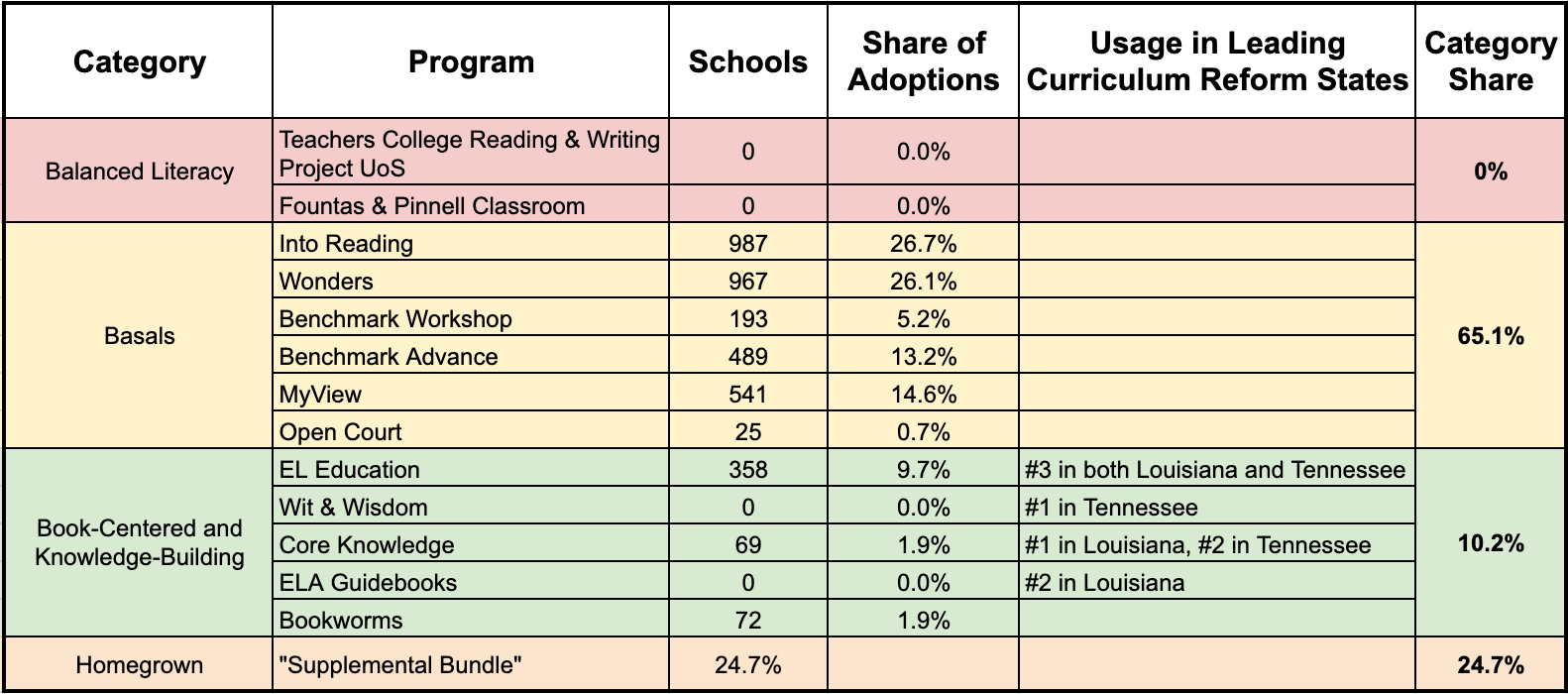
Every single state curriculum list endorses the use of book-free curricula in ELA. At least one basal (Into Reading or Wonders) is on every state list—even in states with strong curriculum reform efforts, like MA, WI, and LA.
Some states are basal strongholds. Witness the grim landscape in Georgia, thanks to its basal-forward list:
Curriculum Chatter
Shawn Datchuk called for more research on curriculum efficacy, while noting the absence of research from state curriculum efforts. (Y’all know this is why I want a National Curriculum Database, right?)
Lauren Brown issued a plea to prioritize content learning. Her opening was fire:
“Call me crazy, but if you give students a passage to read about volcanoes, why on earth would your objective be to find the main idea of the passage instead of, well, to learn about volcanoes?”
Like an echo, Olivia Mullins called for more attention to informational text in the early grades. Amen.
Melinda Karshner took on Into Reading: Its recipe is hard to follow, and HMH is asking teachers to “just fold in the cheese.” 😂
Daisy Christodoulou sent a canary from the British coal mine in Do knowledge-rich curriculums cause mental health problems? TL;DR: England pursues curriculum reforms. Curriculum gets more rigorous. Opponents of changes try to suggest teen mental health crisis is due to curriculum changes. Daisy easily debunks this narrative with data from peer countries.
I updated my tracker on the State of State Curriculum Maps:
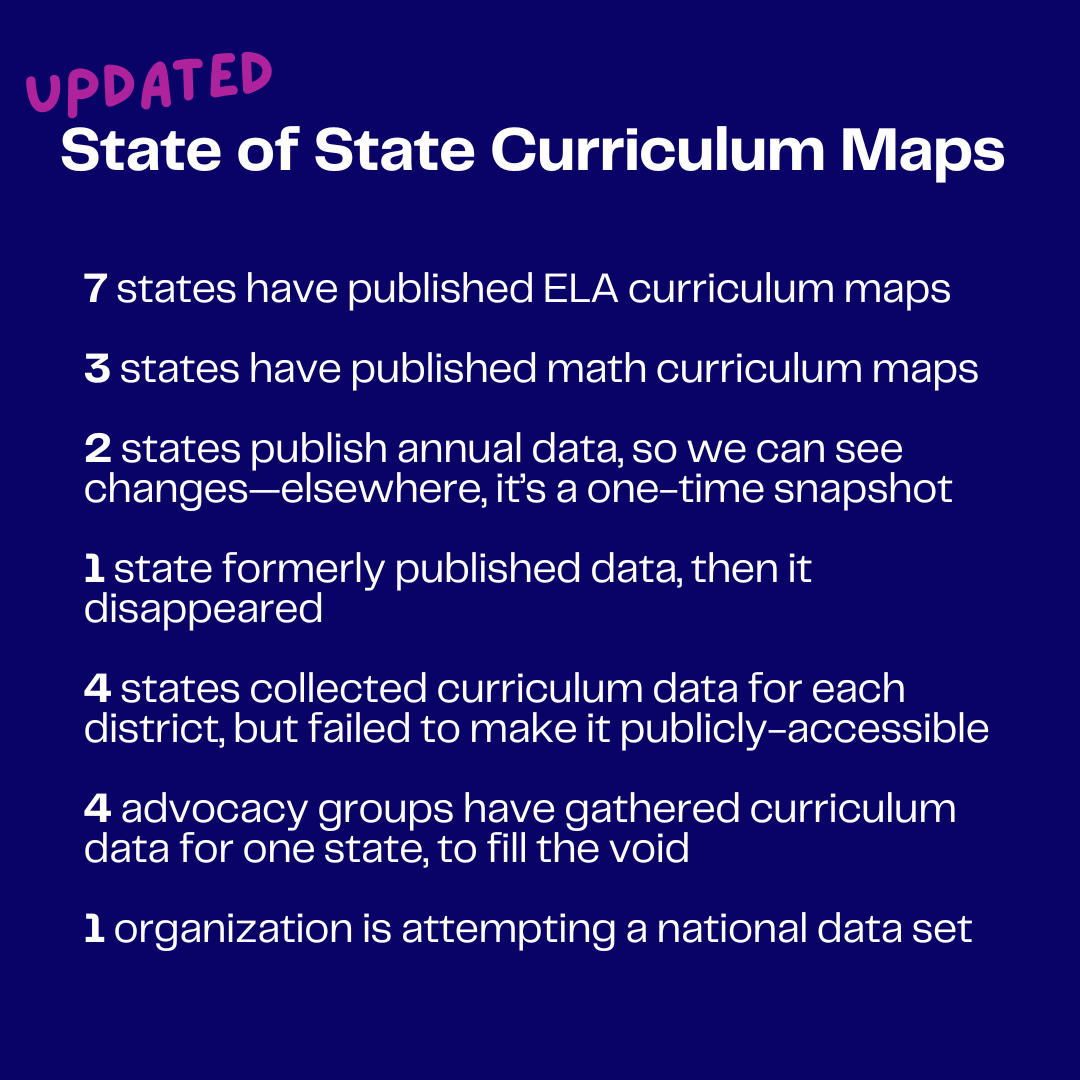
By any measure, this is a troubling lack of transparency. I’d love to see accountability hawks take on this crusade with me. Accountability starts with transparency, amirite?
The Literacy Zeitgeist
Have you heard of the decoding threshold? It’s important stuff, and Rebecca Kockler did a thoughtful interview with EdWeek’s Sarah Schwartz, getting into the weeds. She makes an important point: multisyllabic word decoding connects to morphology and vocabulary, illustrating the need for the Word Mapping Project.
Oral language gets its due in Kindergartners Aren’t Talking Enough in Class. Why That Matters.
A new study provides more evidence that reading volume matters to reading achievement—in this case, via an intriguing model for increasing reading volume by sending books home with underprivileged students.
At Elana Gordon’s school, 97% of students qualify for free/reduced lunch, and more than 80% of 1st graders are hitting or exceeding benchmark, for the second year in a row. They are clearly getting a lot right. This week, she unpacks various layers.
“Substack has basically become my faculty lounge,” writes Katie Baker in a piece on Brett Benson’s Active Observation protocol. True story.
A popular children’s history book series was allowed to go out of print, writes Natalya Murakhver. Bummer.
The British Lens on the “Over-teaching” Conversation
Some day, I’ll publish a piece explaining that the average American school takes a more complex and time-intensive approach to phonics than the average British school, which adds credence to concerns about “over-teaching.” In the meantime, two sharp British teachers are hitting these notes:
Chris Such did an incredibly thoughtful podcast with Zach Groshell.
Mark Goodrich weighed in, noting that some American practices are “bonkers.”
Math Wars
The SFUSD Algebra mistake spread to NY: “Across New York state, more than 1 in 4 schools don’t offer Algebra 1 to eighth graders, found a report.” Ugh.
Don’t Dismiss the Science of Math Movement, says a retired professor.
Greg Ashman takes on Jo Boaler and the State of Education Research.
Instructional Time Matters
A new tool shows enormous variation in school instructional time for Oregon students.
Ohio launched a Chronic Absenteeism Dashboard, because more than 25% of Ohio students were “chronically absent last year, missing nearly one month of school.” Eek.
Much Ado About Accountability
Freddie deBoer’s takedown of the “accountability thesis” made excellent points. I have a few quibbles; Freddie claims the SFUSD math experiment didn’t replicate much, and the study above proves him wrong. Also, a dozen states have lowered cut scores or graduation requirements since 2020, putting pressure on DeBoer’s argument that little changed since ESSA. Still, it’s a superb read.
None the less, this week brought another “states just need to eat their broccoli and Do Accountability” OpEd, this time from Jeb Bush. Y’all.
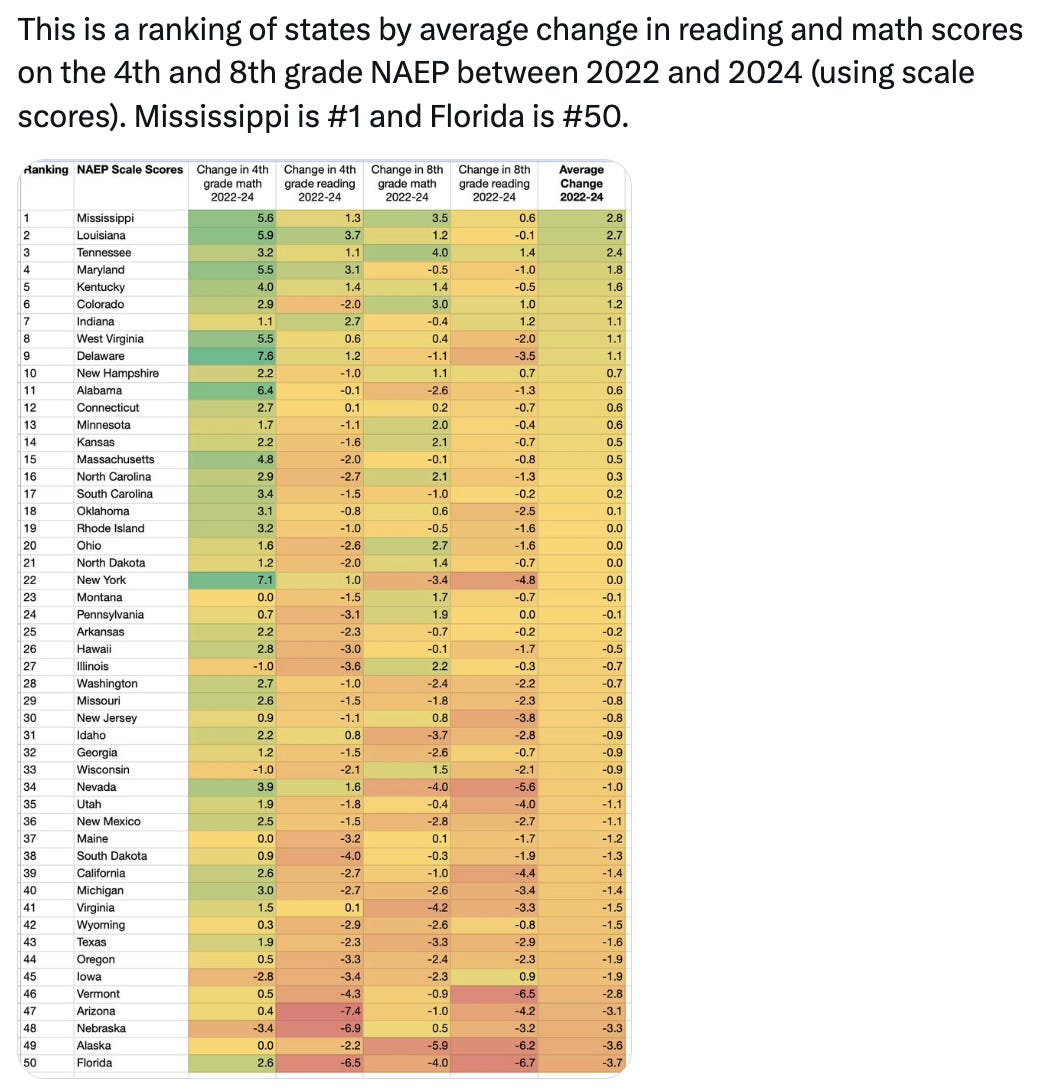
Bush trumpets Florida’s academic gains during his tenure, but fails to mention that Florida became the fastest-declining state in the nation in recent years1. Does accountability have a shelf life?
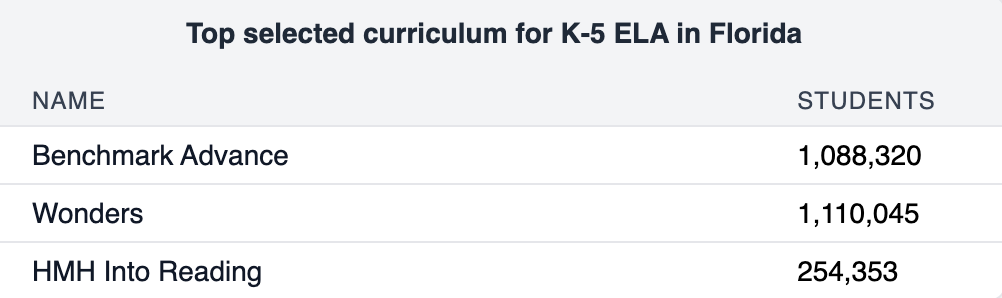
Or is Florida’s weak recent implementation a culprit? I notice no one’s is holding Florida accountable for its unfortunate ELA curriculum adoption, which begat a weak curriculum landscape:
Nor do accountability superfans ever mention Florida’s failure to publish a curriculum map.
If I call curriculum accountability “the spinach of education reform,” can I get accountability hawks to take it seriously?
EduChatter
We now spend One. Trillion. Dollars. on US Education. Chad Aldeman cues the Austin Powers memes.
The New York Times published the second article in a year featuring efforts by districts to market their way to enrollment. “At more than a dozen New York City schools, the entire first grade is just 15 or fewer students.” I wrote about the role of academics in NYC’s enrollment declines last year, and continue to worry for the nation’s largest district.
Ed Tech Backlash Watch
LAUSD moved to ban screens in K-1 and restrict usage in upper grades. Coverage was everywhere. I spoke with the parents behind the pressure campaign to limit Ed Tech in LA; their group has exploded.
One of those parents shared this state report card on school phone policies.
Instagram reels on parent opt-out are going viral.
In the New York Times, You Can’t Game Your Way to a Real Education ran the table on concerns about tech in schools, although it broadcast one misconception: Ed Tech did not take over when the Common Core “unraveled.” It was a distraction from the new Standards all along2.
Andrew Cantarutti wants schools to be sanctuaries of focus in an age of distraction. I love his title: Why Attention Must Become Curriculium.
A mom in Substack stopped me in her tracks with her take on the iReady debate. Are the iReady articles the new “Sold a Story?” Hmmm.
Dunk of the Week
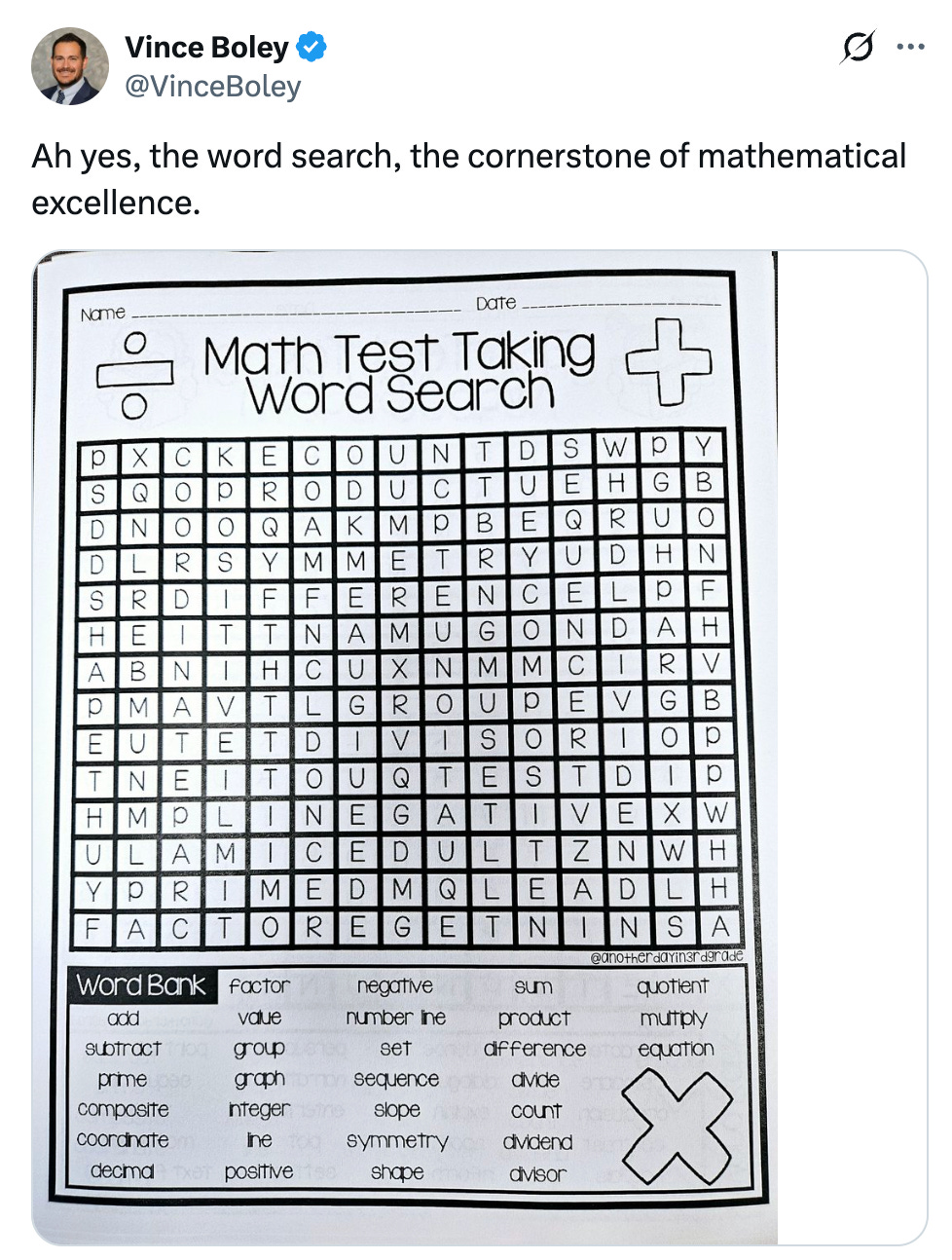
Vince Boley FTW. 😂
Coming Attractions
Did I mention ResearchEd NYC is next weekend, and NYC is gorgeous in the Springtime?
May 5-6: the Reading League Summit takes on data.
June 30th: the Teaching That Succeeds symposium, which is accepting speaker proposals.
September 26: ResearchEd St. Louis. Apply to speak by 5/15.
October 24: ResearchEd Toronto.
Beyond the Edusphere
“Addiction to short-form videos is associated with reduction of brain activity in the frontal lobe and weakened focus” according to EEG study.
New rule: in 2026 and beyond, you can only write about Florida’s reforms if you note this detail:
My one quibble with Worthen’s piece: She is 100% right about the need for a stronger vision of what schools are for. What is the modern canon? Are we OK with book-free English classes, for example?
Yet Worthen is mistaken that Ed Tech took over when the Common Core “unraveled”. Between 2012 and 2018, I was a part of organized efforts to ‘market’ both Common Core-aligned products to schools (concepturally, and then as curriculum) and also efforts to sell Ed Tech to schools.
The demand for Ed Tech, and conviction that it would revolutionize education, was already there in 2012.
iPads and Chromebooks were generally rushed into classrooms with gusto. Selling Common Core-aligned curricula was usually like pushing a ball up a hill.
Frankly, the Common Core never had a chance. Educator mindshare was wrapped up in “Digital Promise” and “Future-Ready Schools.” The latter was a federally-funded effort with an office in the US Department of Education. I could write a book on this. Instead I wrote a Twitter thread, the beginning of my oral history on the rise of Ed Tech.
On those Landmark books going out of print because nobody was buying them anymore....that happened because they are bad.
The first book in the series is "The Voyages of Christopher Columbus" by Armstrong Sperry and virtually every part of the story it tells is factually inaccurate. According to the book, people laughed at Columbus because he told them the earth was round.
"I hesitate, learned friends, to voice it! It is based on the idea that the earth is shaped as a globe! Ah, already I hear your laughter!"
They knew the earth was round but they laughed because they thought his calculations were wrong -- which they were -- and sailing west was not a fast passage to the Indies.
It claims that Spain was poor at the time.
"True, sire, Spain is poor now, but she need not long remain so."
Spain was exceedingly rich at the time but cashflow was tight due to the Reconquista having finished just months prior.
In another book in the series, Prehistoric America by Anne Terry White, the same category of issues exist. Its description of human migration timelines is wrong. Its description of indigenous cultures is wrong. Its paleontological details are wrong. None of this should come as a surprise, really -- the book was written in 1950 and, just as one example, modern dinosaur research didn't kick off until the 1970s.
They went out of print for a reason and no one should mourn their loss.
This is the content I crave about UK vs US phonics teaching. I tried to teach my kid to read using the classic 100 easy lessons book - it worked but was much more painful than just getting some Read Write inc flascards and books. My second son has found it much easier!