

Happy Teacher Appreciation Week!
I’m fortunate to work with a community of teachers who strive to bring research into their classroom practice. In their honor, I’m kicking off with research.
Study These Studies
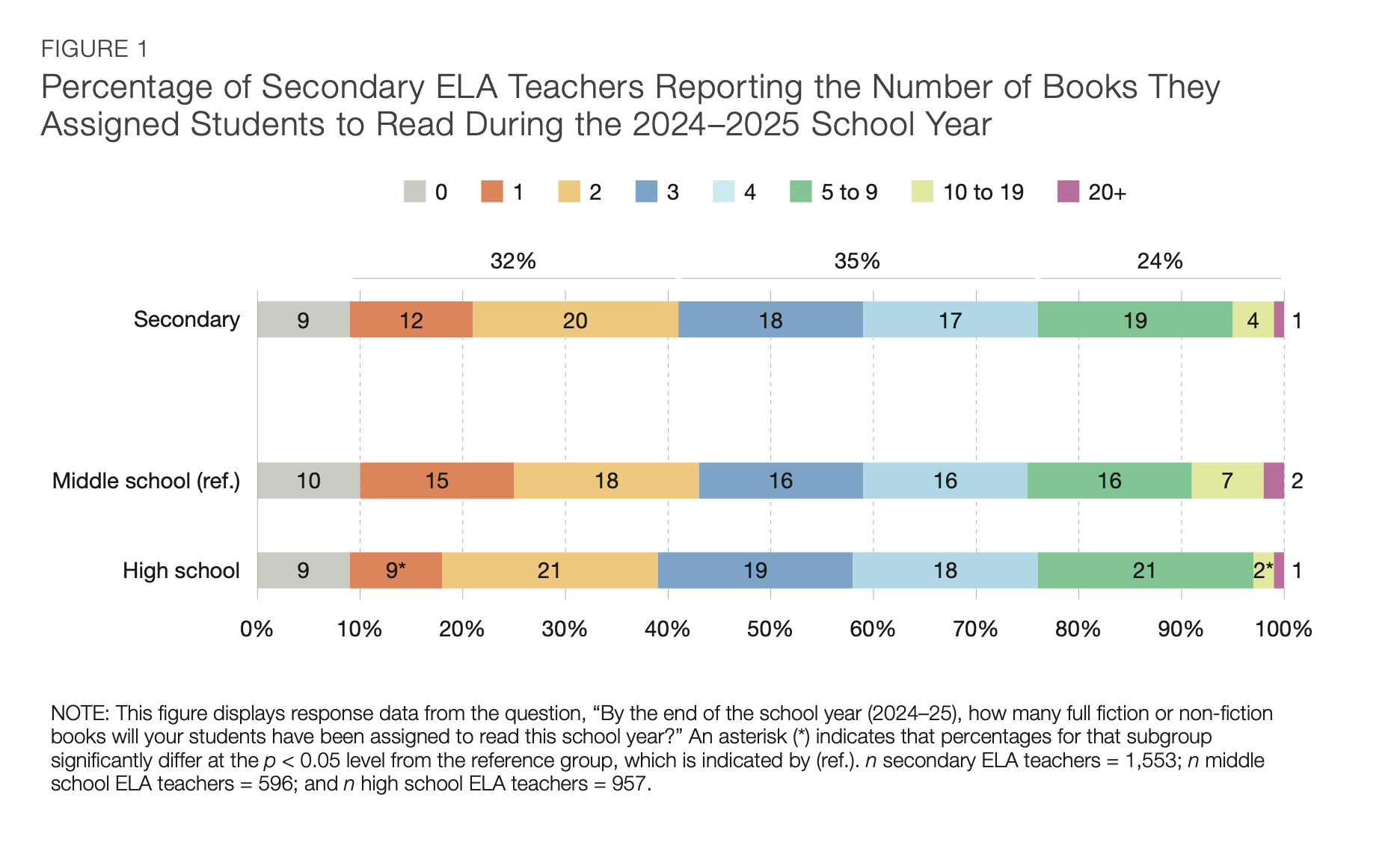
A new RAND study examines the prevalence of books in secondary ELA. The big takeaway: The number of books assigned is simply all over the map. Typically, it’s low (0-3 books). But clearly, it doesn’t have to be:
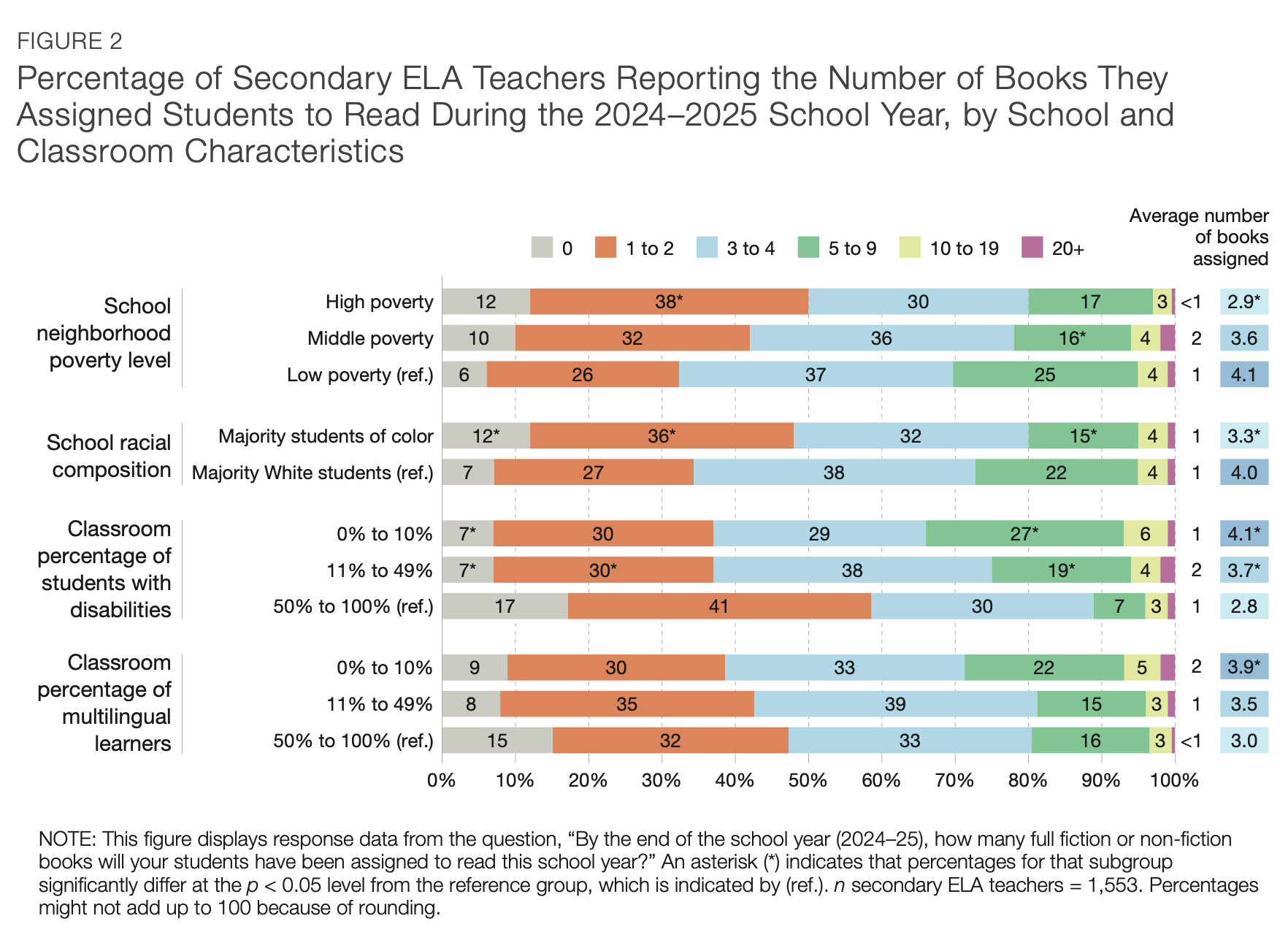
Another finding: “Teachers serving more historically disadvantaged students… assigned fewer full books.” But again, the range is striking, in every demographic:
To the surprise of no one, the study finds evidence that school curriculum is a factor in the number of books assigned.
Two studies drive home the value of pairing decoding and language instruction for struggling readers: one using the RILL intervention and one randomized trial of the UIT-ReadWell program, in which gains were sustained over six months. Don’t sleep on the role of curriculum in these studies.
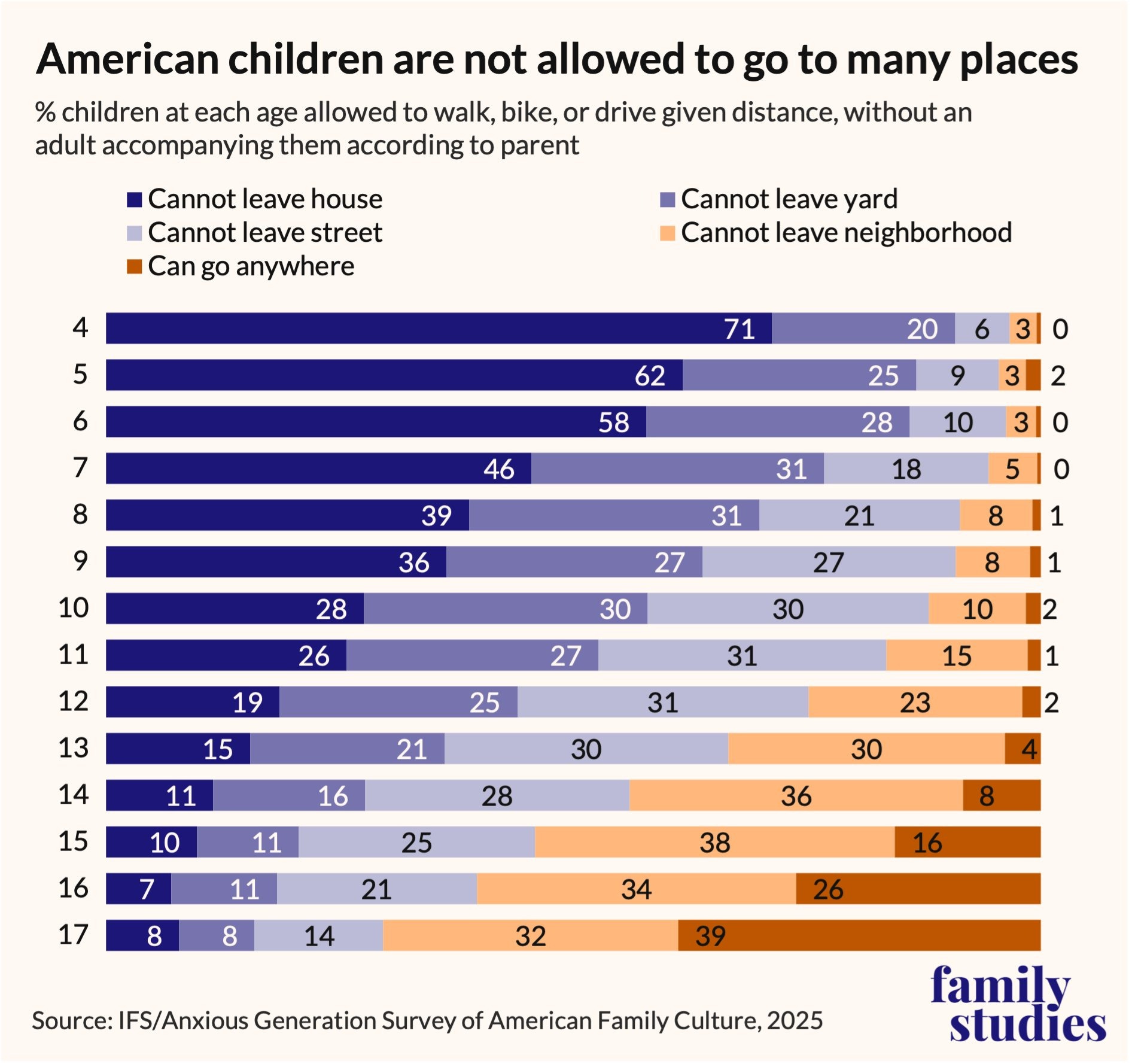
A new study of American childhood shows massive amounts of screen time; even “low-tech” families allow three-year olds to spend 3.5 hours per week on devices. The tech-dominated childhood is also incredibly restrictive:
In the UK, 70% of babies are exposed to screens, and one in ten regularly fall asleep next to a screen, according to a new study.
A new analysis suggests increasing rates of ADHD diagnosis worldwide are socio-cultural, and “linked to two interconnected global cultural processes,” including the rise of child-centered cultural perspectives.
The Study On Center Stage
Because magic bullets are always in fashion, folks apparently expected cell phone bans to reverse academic declines.
So, a new study of schools using Yondr pouches made waves, because it found limited impact on student achievement and attendance.
Much of the internet (and media) treated the study as conclusive—even though Yondr pouches are no one’s idea of the best way to implement cell phone bans, and the bans were all relatively new.
Most gave short shrift to the positive news in the study: improved student well-being and increased teacher satisfaction.
Chad Aldeman lamented our desire to find One Culprit (like tech) for academic declines. Educators shot back: “It IS the screen that contaminates the learning environment.”
SoR and Mandate Debates
The Fordham report continues to reverberate.
For all the focus on cueing, Natalie Wexler pointed out teachers’ even weaker grasp on reading comprehension.
The report is renewing calls for state mandates on curriculum. Mike Petrilli started the week asking the right question: What if states get it wrong? This did little to quell mandate fever, based on the reactions.
I feel a rant about the tragic state of state lists coming on.
The Literacy Zeitgeist
Are we doing enough to promote continuous blending in kindergarten, to bridge the transition to first? Elana Gordon reflects on the signals in her data. Abby Boruff shared her approach.
Laura Stam described her multi-strategy approach to supporting a struggling second grade reader.
Melissa and Lori spent April podcasting on vocabulary. This episode with Margaret McKeown earned raves! May is comprehension month, but there’s no shame in April catch-up.
Doug Lemov wants to re-center the text in ELA classrooms, and he offers a collection of models.
Math Matters
Sarah Schwartz reported on upper grade math struggles. The recurring theme: lacking math foundations.
Loads of elementary teachers are using Brian Poncy’s Facts on Fire to supplement their math curricula. Gene Tavernetti’s interviewed Brian for his podcast.
Learning on Learning
Dylan Kane details his approach to fine-tuning amounts of practice to ensure students retain new math procedures. It’s a wonderfully-clear explainer.
Ms. Sam shares methods for making Mini Wipeboard lessons effective: the Tick Trick and Carousel Teaching.
Can a six-year-old who doesn’t understand sound waves “figure out” how to develop an investigation to demonstrate sound waves? Olivia Mullins’s questions about the NGSS got a second hearing.
Writing on Writing
The New York Times surveyed teachers, and confirmed a trend: they are moving writing assignments into classroom time, because take-home assignments have become unreliable in the age of AI.
There’s a really important rub, as Natalie Wexler pointed out:
“Many teachers have discovered that the only way to ensure students read a whole novel, or any complex text, these days is to do the reading in class—which obviously takes up a huge amount of time, especially at higher grade levels when novels are longer. And now students also need to do all their writing in class? It’s hard to see how this will work without limiting both reading and writing to extremely short texts.”
Katie Megrian discussed a common culprit in much weak writing: a knowledge gap preventing students from writing what they know.The Amen Choir was loud.
Pivoting on Ed Tech
By now, everyone has received the memo: there’s an Ed Tech backlash. The coverage, like this week’s Washington Post feature (“Why some schools are cutting back on the technology they spent billions on”), is getting a little redundant. So, I’m dialing back the Ed Tech Backlash Watch, in favor of breaking news. After all, WaPo gave us this stunning quote, so the mic has officially been dropped:
“Ed tech is just big tech in a sweater vest.”
Now, to the solution engineers…
Can students learn via short form videos? Carl Hendrick does a deep dive into the research. Becky Allen also analyzes the utility of AI-generated video in learning. The question eludes simple answers, and I promise their interrogation will push your thinking.
EduChatter
Matt Yglesias thinks we should pay better teachers more, especially given the clear political support for the idea.
Bloomberg calls to include test scores on report cards, in order to counter grade inflation.
The New York Times covered the K-12 enrollment crisis. Today’s declines are “the tip of the iceberg.”
I enjoyed Tim Daly’s case for the chalkboard and McGuffey readers as the OG force multipliers in education. More in What If Peak Ed Tech was 200 years ago?
Coming Attractions
This Week, May 12th: the Science of Reading Classroom teachers host free professional learning on Getting the Gist.
May 16: Read Washington hosts A Conversation with Dr. Jan Hasbrouck about Comprehension & Fluency
June 30th: the Teaching That Succeeds symposium, which is accepting speaker proposals.
ResearchEd has events in Atlanta in June, St. Louis in September, Toronto in October. It’s the last week to apply to speak at ResearchEd St. Louis.
Smile!
Sometimes the memes just make themselves.
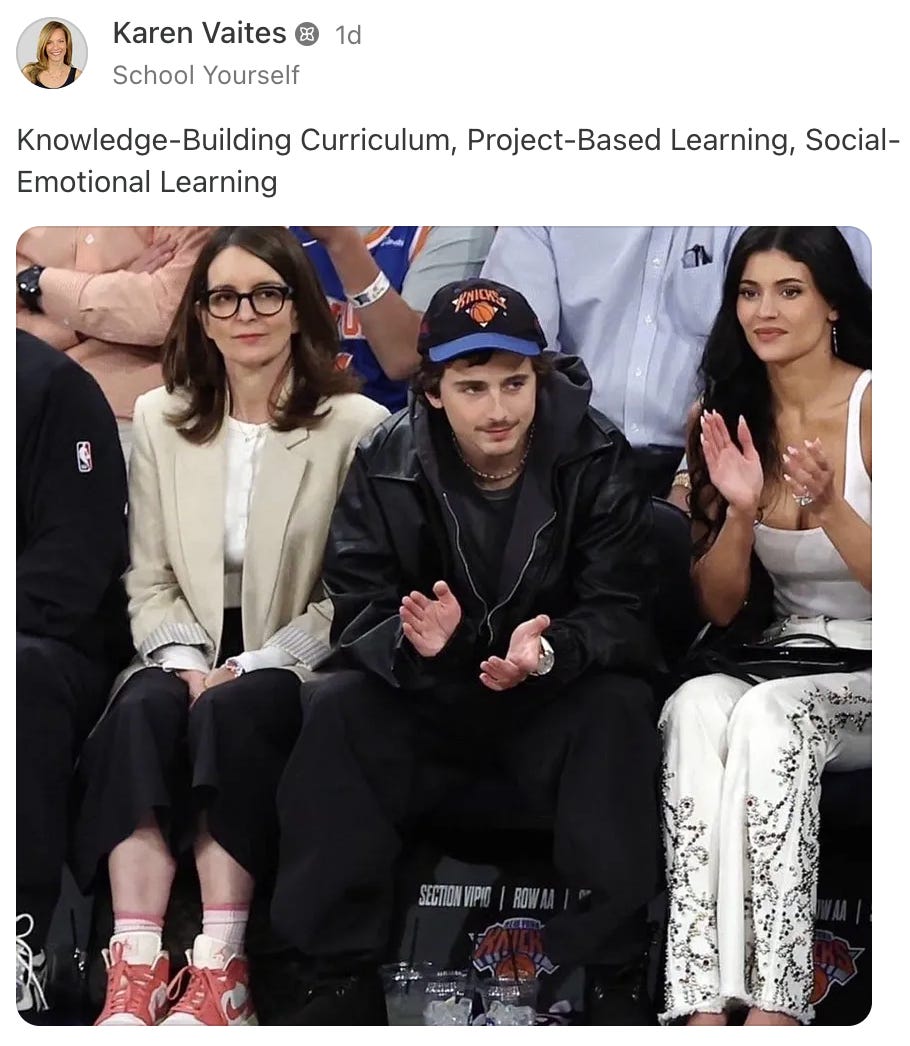
Also, in the Knowledge Matters to Comprehension Series, I give you: Putin on the Ritz.
Suggestion Box
I had hoped this weekly roundup could become a hub for folks to drop reactions and comments, including “here’s a piece you missed.” Please drop ‘em if you’ve got ‘em!
Also, I know I’m spanning a broad array of topics, but every week, at last 25% of readers click a link, and the top 5 links are all over the map. My readers are a broad church!
None the less, I’m always open to suggestions on how to make the content or format work better.
Keep at it! Anyone in education should be reading broadly and your posts help. Thank you. Love that more folks are finding Facts on Fire!
I really need to read the Fordham report properly but everything I have seen quoted from it is quite alarming…