

For my money, Tennessee deserves a lot more flowers for its leadership in reading and math.
The Volunteer State implemented similar reforms to Louisiana, but in roughly half the time. Truly, a remarkable cascade of programs have dropped since 2018.
Critically, this work has been embraced by educators. Tennessee achieved unprecedented success for its curriculum reforms: two years into its last ELA adoption, 96% of teachers reported that they primarily used the materials adopted by their districts.
Its pioneering teacher training also earned high marks from teachers. Tennessee’s Reading360 training was homegrown (developed in partnership with TNTP) and designed to be hand’s on. Teachers learned about reading research at the front end of the training. At the end, they worked with their actual curricula, and modeled lessons for each other.
Thanks to this tangible approach, 97% of attendees gave the training high marks for utility. Tennessee offered $1000 stipends for completing the training, a nice show of respect for teacher time. The state trained nearly all of its elementary teachers over the course of two summers—the fastest pace of any state.
Best of all, it raised reading outcomes, according to a study by the Tennessee Reading Research Center:
“The average TN-URS performance among the full sample of K-1 students was significantly higher when they were taught by teachers who completed one or both Early Reading Training courses compared to their peers in the control group taught by teachers who did not participate in training.”
I believe Reading360 training should be the national model. Recently, Tennessee has also begun offering training to PreK teachers. Huzzah!
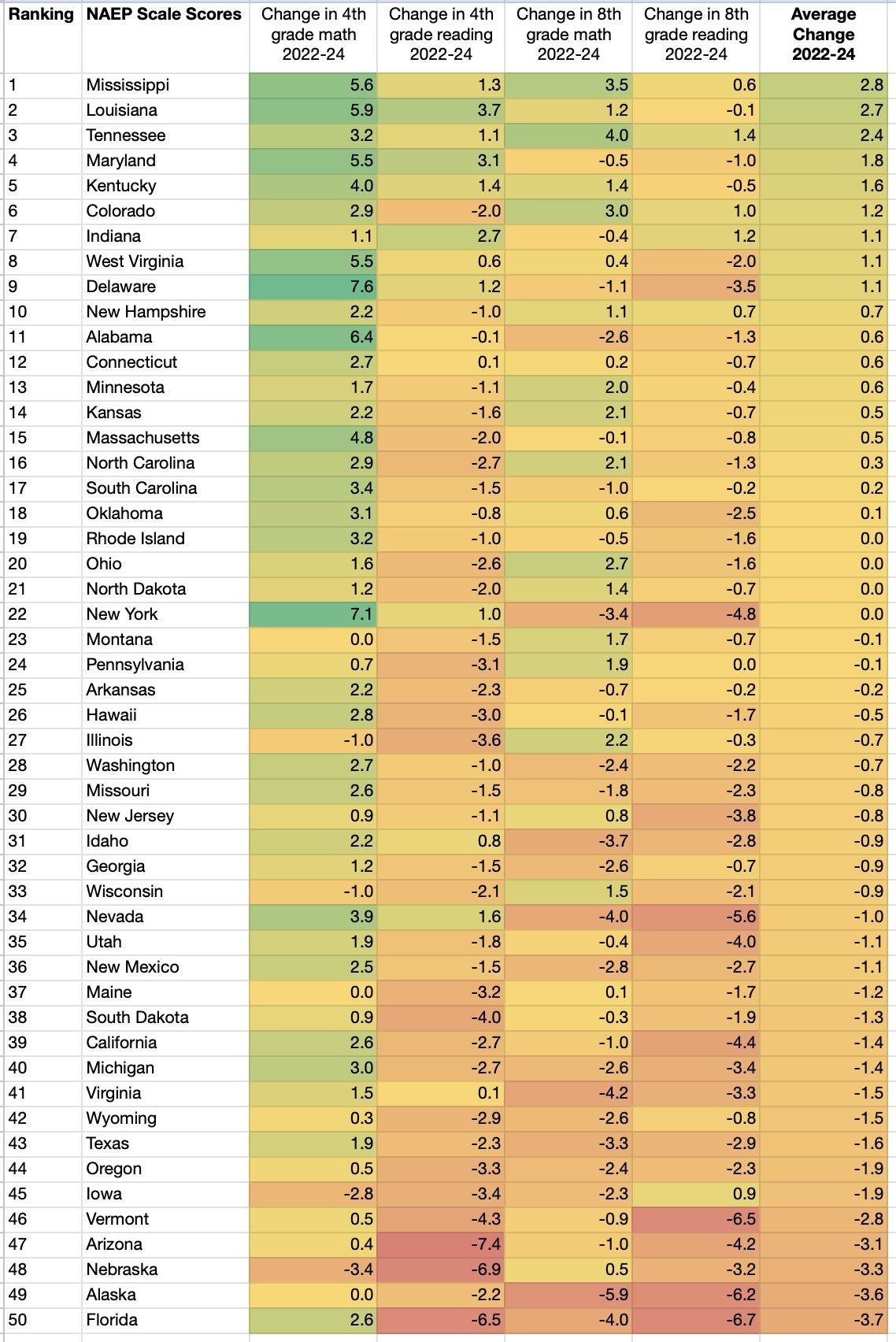
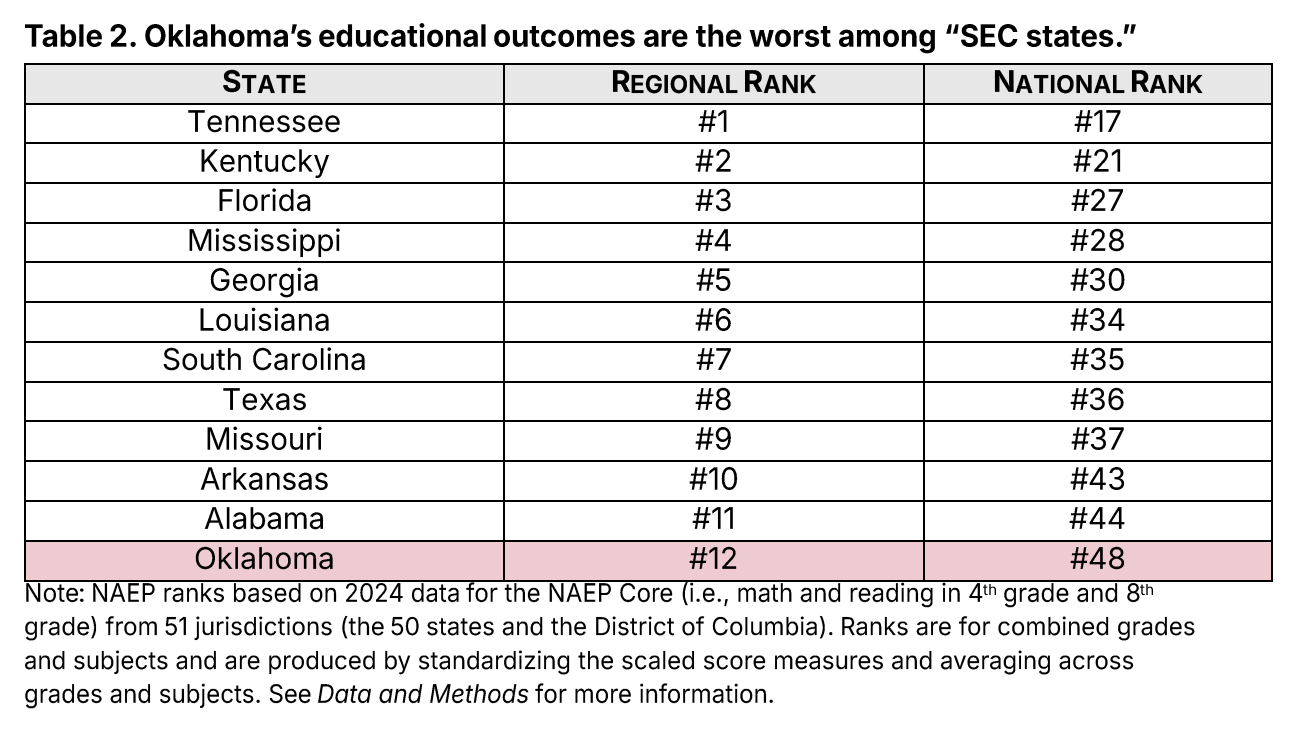
The Volunteer State has solid gains to show for its efforts. It’s in the top 3 states for NAEP gains in the last two years1. A new report by Adam Tyner puts Tennessee at the head of the class2, compared to peer states.
For all these reasons, I’ve been sorry to see Tennessee missing from some of the national coverage of the Southern Surge.
Today, it’s my pleasure to share fresh insights from Lizzette Reynolds, Tennessee’s Commissioner. We’ll be sharing the stage at ASU+GSV, discussing ways to advance the Southern Surge. Whether you’re in San Diego or not, I want you to hear her thoughts.
Straight from the Commissioner: a Q&A with Lizzette Reynolds
What would you like people to know about your state’s work that isn’t getting a lot of attention in the media coverage?
Commissioner Reynolds: Tennessee’s continued commitment to high-impact literacy strategies has driven record-high student proficiency rates every year since 2023. We believe sustained literacy gains have had a ripple effect on the recent gains Tennessee has experienced in all tested subjects across all grade bands.
Our efforts remain steady, with ongoing measures of impact and constant refinement of supports to improve literacy outcomes. We consistently implement evidence-based practices, including direct instruction grounded in the science of reading and the use of high-quality, knowledge-building materials. The Centers for Regional Excellence (CORE), under the Office of Academics, directly support district implementation of HQIM.
Throughout the year, we offer a combination of in-person and on-demand training for teachers and instructional leaders. Recently, adolescent literacy grants were awarded to nearly half of Tennessee’s districts, and almost 1,000 pre-kindergarten educators received foundational literacy training for the first time last summer3. Collaborative preparation and student work analysis among general, special, and English learner educators are generating promising results in accelerating learning for all student groups. In addition, the department monitors educator preparation program (EPP) literacy training, and a new EPP literacy network is launching to further support educator readiness to teach reading from the first day of instruction.
The Tennessee Investment in Student Achievement (TISA) funding formula also prioritizes early literacy through direct funding for literacy supports in grades K-2 and outcomes funding for students that are proficient by the end of third grade and those that were not proficient in third grade but improved their performance level on the state assessment by fourth grade.
The state letter-grade accountability system, implemented in 2023, clearly communicates progress at the school level and provides transparency to parents and other stakeholders. We want to acknowledge that this work would not have been possible without districts and teachers, whose dedication has been essential at every stage. As other states look to replicate this success, Tennessee’s experience shows that sustained, comprehensive investments in state-led, locally implemented literacy strategies can yield the strongest and most lasting results for students, schools, and communities.
What’s your biggest concern about the “Southern Surge” story and how it is being told and understood?
Commissioner Reynolds: The Southern Surge marks a significant achievement for advocates of explicit, systematic reading instruction for every child. Years of advocacy, research, and policy work have led to this moment, which deserves recognition.
But we can’t stop there.
Strong policy is critical, but it is only the beginning. A state may have the best reading legislation yet still have eighth graders who can decode text without comprehension. This remains the literacy crisis, though it may appear differently.
To maintain this momentum, we must expand our focus beyond early grades and address the full scope of literacy development. Comprehension begins from the first day of instruction, not just in middle school. The Southern Surge requires us to both sustain early literacy efforts and ensure that every child develops the knowledge, context, vocabulary, and curiosity necessary for true understanding.No state has fully established this continuum, which is where the Southern Surge could falter.
In Tennessee, we recognize this need and are committed to advancing our efforts. With a $27 million grant from the US Department of Education, we have launched new initiatives in adolescent literacy this year. This progress does not come at the expense of our early literacy work. Both areas are essential for student success, and our district leaders and teachers are prepared for the challenges ahead.
Our challenge is not limited to middle school; it is a systemic issue that begins much earlier. Sustaining this movement requires us to look beyond third grade and insist on instruction that is content-rich, builds knowledge, and prepares every student for success after graduation.
Congress is contemplating action on the Science of Reading. What would be at the top of your wish list for federal action?
Commissioner Reynolds: Federal support is essential not to direct how states teach reading, but to accelerate the work that states are already leading, particularly in implementation.
Congress can play a constructive role by:
Supporting teacher preparation reform efforts so new educators graduate fully prepared to teach reading using evidence-based practices.
Investing in high-quality professional learning, especially for practicing teachers who were not trained in the science of reading.
Providing flexible, sustained funding streams for tutoring, early literacy intervention, and high-quality instructional materials. Comprehensive Literacy State Development Grants have been significant in Tennessee’s investments in literacy and associated statewide strategies.
Encouraging strong research partnerships to help states evaluate impact, identify effective models, and share lessons learned.
Improving data transparency at the national level so states can compare progress and better understand the impact of policy choices without adding burden to districts.
Related Reading
Don’t miss Lisa Coons’s column on Reading360 training, unpacking the details. The TNTP team also shared their insights.
If you’re reading this, you probably care about Southern Surge replication. I recently wrote about the weak track record of policy to spawn change in Policy is Not Progress.
Want details on some specific state stumbling blocks in reading reform? Find them here.
Here are the scale score rankings, care of Marc Porter Magee:
Here’s Tyner’s ranking of “SEC states” (and yes, I got a chuckle out of a state comparison born of a college football conference).
I asked for more detail about this PreK training, and the Tennessee team shared this:
“The department launched the optional Foundations First: Pre-K Reading Training in June and July last year, which helps educators prepare students in Tennessee pre-k programs for kindergarten readiness. Throughout the summer, over 950 pre-K teachers and educational assistants from 97 districts participated in in-person sessions across the state to receive direct support in implementing foundational skills.
A specific emphasis and prioritized focus on their literacy training and use of instructional materials is being prioritized for direct training opportunities. Ensuring Pre-K Educators and teaching assistants are familiar and confident in utilizing their foundational literacy instructional materials.”