

Coming off Spring Break, I’m sure I’ve missed articles from the last week-plus.
If any of us miss articles, it’s probably because social media is so screwy nowadays. Nate Silver wrote an eye-opening analysis of the current social media “freak show,” and it fits with my own sense of Twitter’s decline (generally, and especially for education discourse). A viral video explained how political influencers collude in Twitter, which doesn’t help.
As EduTwitter flounders, long live Substack!
Thanks for reading (and sharing) this newsletter as I attempt to stitch together EduTwitter-discovery-but-in-Substack.
Viral For Good Reason
The Cost of Over-Teaching Phonics was everywhere… for good reason. Liana Loewus clearly explains the ways over-teaching can manifest.
Mark Seidenberg echoed its themes in his new Substack.
On Center Stage
The New York Times featured Mississippi on its influential podcast The Daily.
Rachel Canter argued that accountability is the secret sauce of Mississippi’s success in The Atlantic. Accountability fans cheered. Based on my own citizen journalism, I’m not convinced “accountability” is the best explanation for Mississippi’s success, and Sarah Mervosh’s NYT reporting helps cement my case. More on this in the footnotes1.
Have you looked at the national track record for literacy policy? Spoiler: it really isn’t good. I collect numerous points of evidence in Policy is Not Progress.
As if on cue, New York state reminded us that state leaders tend to double down on their terrible policy decisions, rather than course-correct. Sigh.
The Shanker Institute celebrates Maryland’s choice to hire Carey Wright as a signal of bipartisan embrace of reading reforms.
Curriculum Matters
David Steiner makes essential points about the role of strong curriculum in high-performing countries. Huzzah! But, I was bummed to see EdReports boosted to school boards in this piece, given the issues with its work.
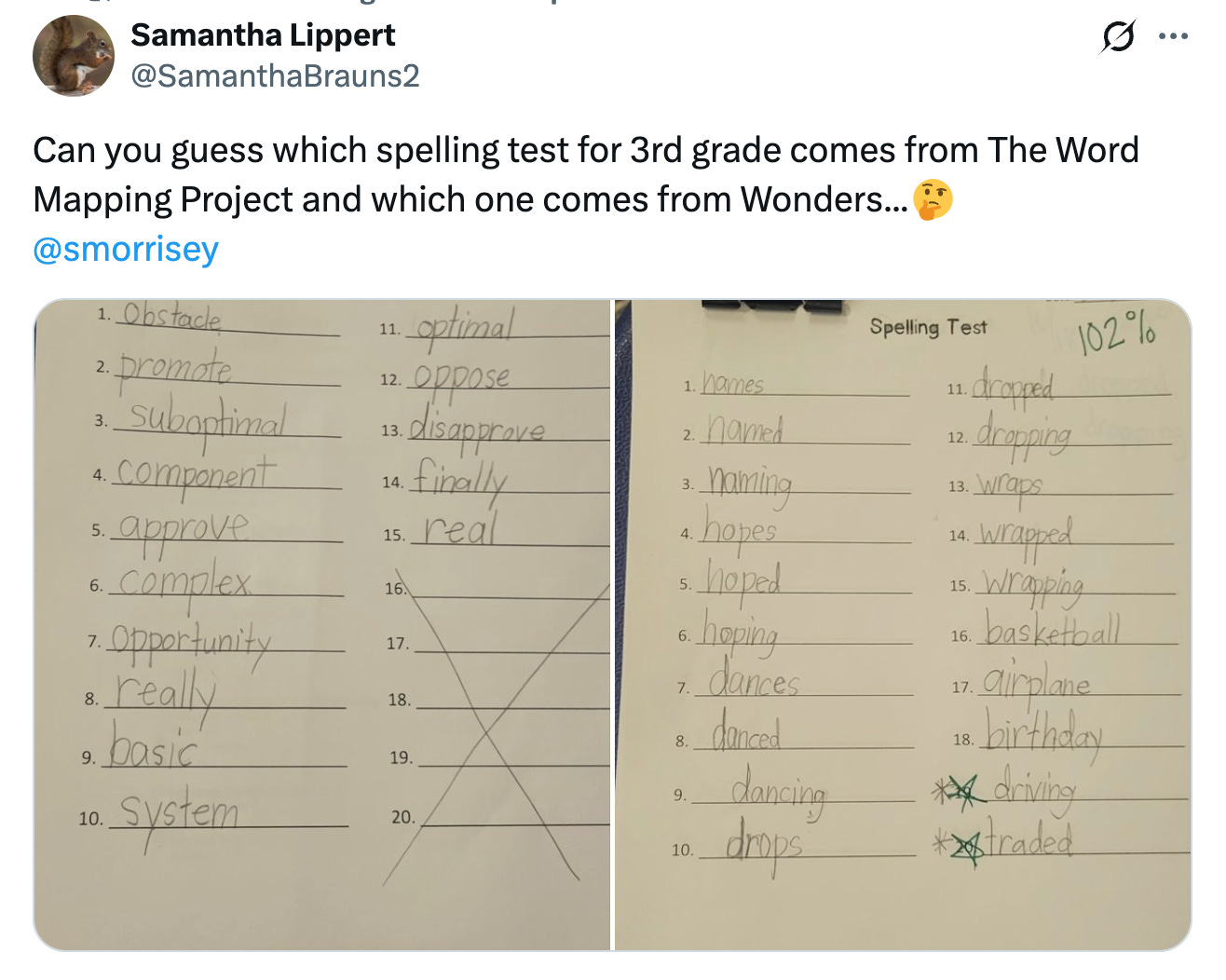
Tweet of the Week went to Samantha Lippert. The hot takes wrote themselves! Truly, you shouldn’t miss the Word Mapping Project.
The Literacy Zeitgeist
Assigning at-home reading to parents helps to boost reading comprehension.
Doug Lemov pens a love note to formative writing.
Mark Seidenberg explains What Hollis Scarborough’s Research Tells Us About the Language Origins of Dyslexia.
Laura Stam is back with more on Opportunities to Respond.
Learning on Learning
Dan Willingham’s excellent piece on students’ attention has been revived in AFT’s magazine: Ask the Cognitive Scientist: Do Today’s Kids Have Reduced Attention Spans?
It’s impossible to miss the way the “science of reading” crowd has increasingly been equally (more?) invested in the Science of Learning:
Teachers were teaching other teachers about retrieval practice—you can watch a recording!—and the actionable learnings clearly stuck.
I wish I had time to write about the raging Math Wars, because there’s much to say. Math Needs Its ‘Science of Reading’ Moment offers a good example.
Ed Tech Backlash Watch
What Happened After a Teacher Ditched Screens in The Atlantic, featuring Dylan Kane’s story.
Daisy Christo has a really thoughtful take in Education technology is never neutral.
EduChatter
Everyone is buzzing about outcomes-based contracting models which “put both vendors and school districts on the hook for results.” Greg Toppo reports.
Coming Attractions
This week: Learning and the Brain is live from New York and available virtually April 16-18. Hear Dan Willingham, Natalie Wexler, Sarah Oberle, Leslie Laud, ++.
Join me at ResearchEd NYC on May 2nd!
ResearchEd St. Louis is coming in September. Apply to speak by 5/15.
A new Teaching That Succeeds symposium has been announced for June 30th, and the stellar organizers are seeking speaker proposals.
Beyond the EduSphere
Walking rewires your brain, and sedentary behavior shrinks it. Go for a walk today!
The Back Catalog
Last week, I really enjoyed putting together a ‘greatest hits’ list of articles that live rent-free in my head. Check it out if you missed it.
My take on Canter’s piece and the revival of the Accountability Theory of Change:
I would agree that states are trying to replicate Mississippi’s work without getting the specifics right. Readers will know I have a lot of angst about the oversimplification of the Mississippi story.
And the need for strong execution, one of Canter’s themes, is a key point in my own piece this week, Policy is Not Progress.
But I find Canter’s take in The Atlantic to feel a bit technocratic. No, Mississippi’s success isn’t Just Phonics, but it isn’t Just Accountability, either. I’m missing the classroom-centered elements in her Atlantic writeup: the Mississippi state literacy coaches and teacher training investments (and eventually some progress on curriculum). In her longer report, Canter apparently talks more about the instructional stuff (great!), but the executive summary version matters most.
In my own conversations with Mississippi educators, they focused on the parts of the work that were closest to classrooms: coaching, training, screening, curriculum, and yes, the human impact of retaining children who weren’t successful by third grade. If you want to improve reading outcomes, you need to improve instruction, so it pays to think about the influences on the human beings delivering said instruction.
This observation crosses states. I went into the weeds about my Tennessee conversations, which centered instruction.
In The New York Times, Sarah Mervosh’s reporting echoed my own read:
"If you’re in the bottom 25 percent of schools, they send a literacy coach into your school…
I talked to some of the teachers, and they were just thirsty for the knowledge and for the help. And I think if you could just have a mentor, basically, to help you every time you get frustrated or confused and that person was not there in a punitive way. And that’s very important. In Mississippi, they are state employees, but they’re not there to punish. They’re really there to mentor and coach and spread best practices. Like, hallelujah. I would love if someone could just help me every time I was struggling with a story."
For certain, Canter is correct that accountability played a role, especially inasmuch as she puts screening and retention into the accountability bucket. Mervosh notes the role of accountability shifts, as well.
Still… I worry when I see EdReformers taking pieces like Canter’s and proclaiming, “It’s Accountability!”, as if this was a Mississippi Magic Bullet.
It bears restating:
An Accountability Theory of Change assumes that schools know what to do to raise outcomes, and if we just put the right carrots or sticks in place, they will do it. I don’t actually believe that’s the case, writ large. In the American education ecosystem, educators receive (and often believe) loads of misguided signals about what works to improve outcomes.
Put another way: If states implemented new, tough accountability schema today, schools would be just as (or more) likely to embrace the newest faddish tech-enabled solutions (“just like iReady, untested for efficacy, but now AI-enabled so it’ll work this time!”) as they would to embrace better curricula, like those in Louisiana and Tennessee.
If reforms don’t ultimately influence instruction, I don’t expect gains. I hope we all agree about that. I would not have expected gains in Mississippi without the close-to-classroom work.
Further, I must say, as someone who talks with a lot of teachers and school leaders, I don’t see much evidence that teachers sit in classrooms sweating the state’s new A-F school rating system, turning such efforts into a core motivator. SorryNotSorry, accountability superfans.
Lastly, I’d challenge the idea that Mississippi is the promised land of accountability when we don’t have a window into the curriculum used by each district. For me, transparency is an important enabling condition of accountability. Most states fall very short on curriculum transparency, and Mississippi’s one of ‘em.
Ultimately, I don’t over-emphasize the A-word in my own Southern Surge writing because it hasn’t emerged as one of the primary pillars of the work in my conversations with educators. If state accountability systems were a big part of the reform efforts in those states and I missed it, it’s because educators on the ground weren’t talking about it. Which kinda makes my point.
For clarity, I’d rather states have solid and well-designed accountability systems than none at all. Mississippi’s framework has smart details, like a formula for school performance that double counts the improvement of students in the bottom quartile. I like that a lot, given the role of demographics in performance.
I’m just not convinced that accountability moves the needle as much as others think it does.
And IMHO, the reforms where accountability meets classroom practice are the most interesting. Early reading screening appears to both inform and also to motivate. It may be especially motivating to parents, so it pays to make sure that screening policies include parental notification policies, starting in kindergarten. Third grade retention will remain controversial, but it does seem to change adult behaviors. I’ll keep focusing on these two parts of the accountability pie, because they seem to move the needle.
A fair question after reading so much discussion about cognition, brain science, and theory:
What is the outcome in actual classrooms?
After more than 33 years of NAEP results, English teaching continues to produce the same pattern—large numbers of children and teens not reaching proficiency. Now we are looking at yet another cycle, with additions like the Science of Reading, while the core structural issues remain unchanged.
So the question becomes:
Where are the complete, authored English teaching courses—
designed from the ground up, logically structured, sequential, and proven over years of real-world use with:
children, teens, and adults
L1, L2, and ESL learners
both immersed and non-immersed environments
Because without that level of design and proof, discussion remains largely theoretical.
Research, analysis, and cognitive insight are valuable—but they are not substitutes for a complete, working teaching system that consistently delivers results across populations.
At some point, the field has to move beyond describing learning and toward building and demonstrating solutions.
Until then, we risk continuing the same cycle—
more commentary, more frameworks, and the same outcomes for the children. @gogienglish